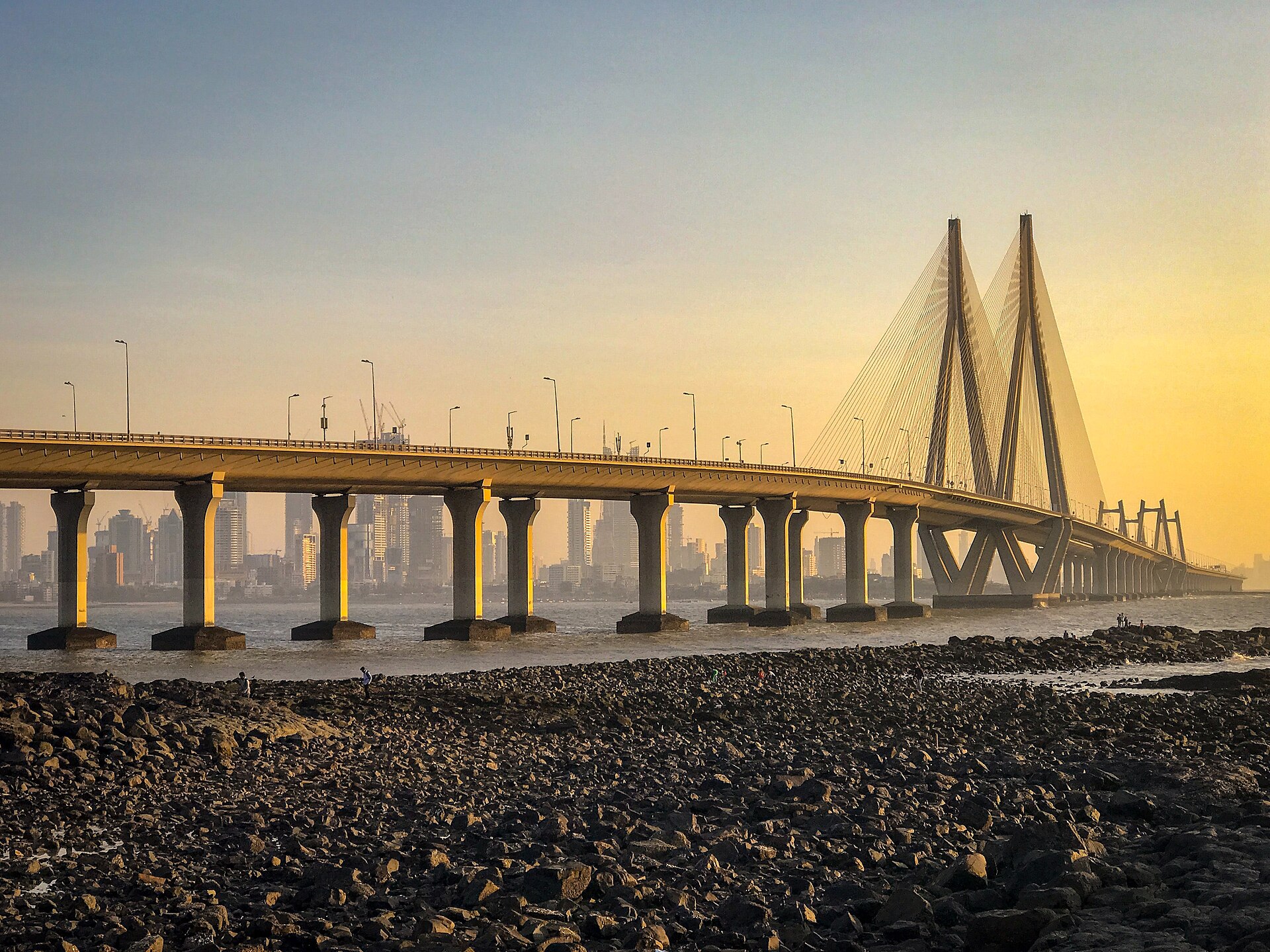
Maharashtra · West coast
Mumbai
The trade’s home: Saffronart, AstaGuru and Pundole’s, Chemould Prescott Road and its peers, Jehangir Art Gallery, and the Ambani cultural center to the north.
Photo: Rutiknatekar, Wikimedia Commons, CC BY-SA 4.0.
Biennale / Country hubs / India
Country hubs · Free to read · Updated October 5, 2026
Country hub · Asia
The money has arrived ahead of the institutions: records in Mumbai’s salerooms, private museums on a national scale, and a narrowing space for artists who dissent.
Autumn 2026
On April 1, in a Mumbai saleroom, a painting of the infant Krishna by Raja Ravi Varma sold for $17.9 million with fees. It was the highest price paid at auction for an Indian work of art, and it was set in India, in rupees, by an Indian buyer, for a picture that the law forbids anyone to take abroad. The Art Newspaper’s report named the buyer as Cyrus Poonawalla, founder of the Serum Institute. The previous record, for M.F. Husain, had been set a year earlier in New York.
That sale holds most of what matters about art in India this autumn. Private wealth is deep and growing, and it is buying at home. Taste at the top is conservative, and proud of it. The state helps with a tax cut and a Venice pavilion, and otherwise leaves the building of museums to families: the Nadars in Delhi, the Ambanis in Mumbai. And the same year has an artist in jail after a labor protest, and one of the country’s senior dealers speaking openly of self-censorship.
The thesis of this page is that India’s art economy has outrun its public institutions, and that the gap is being filled by private ones on a scale few countries have seen. The country’s one international biennale, in Kochi, lost its founding president in January and has yet to name another. Its largest fair belongs to a private fair group. Its national academy has been under direct government control since 2015. The energy is real. So is the question of who will be answerable for it.
The market
No agreed figure exists for the size of the Indian art market, and the Art Basel and UBS Art Market Report 2026 does not give India a line of its own. What can be measured is the auction room. Ravi Varma’s Yashoda and Krishna, painted in the 1890s, carried an estimate of $8.6 million to $12.9 million at Saffronart and hammered at $15 million, or 1,672 million rupees with fees. The evening made $30.7 million. Husain’s Gram Yatra, the previous record holder at $13.7 million, sold at Christie’s in New York in March 2025.
The wider trend runs the same way. In a survey of the market last November, The Art Newspaper’s Kabir Jhala reported that auction turnover for South Asian art was expected to double its last peak, in 2007. The houses doing the selling are Indian: Saffronart, AstaGuru and Pundole’s in Mumbai, with Prinseps beside them. Results for the last three in 2026 were not found for this page and are not given.
The fullest count so far arrived in September. The Collector’s Guide 2026, a report from the wealth manager 360 ONE summarized by Business Today, put auction turnover in 2025 at 2,543 crore rupees, a 10-year high, against 792 crore in 2015. Of 5,059 lots offered, 4,057 sold. The money pools at the top. Husain alone accounted for 490.3 crore rupees, Tyeb Mehta for 307.5 crore, and F.N. Souza for 274.6 crore; post-war art took 1,647 crore and contemporary art 163 crore.
The buyers have changed too. Art Basel’s own reporting in February found that 60% to 80% of current buyers are new to the market, and that most are Indian or based in India. In 2005, by the same account, 60% to 70% of buyers were outside the country.
The government moved on tax in 2025. The goods and services tax on art fell from 12% to 5%, a change the same report says was made partly to soften the effect of United States tariffs. The report, filed from Art Mumbai, also noted bonded status for the first time that year, which means import duty is paid only on works that are sold and stay in India. That makes it cheaper for foreign galleries to show.
One rule cuts the other way. Under the Antiquities and Art Treasures Act of 1972, the work of a short list of artists, Ravi Varma among them, counts as national treasure and cannot be exported. The record price was therefore set by a field of bidders limited to India. Ashish Anand, chief executive of the gallery DAG, told The Art Newspaper the result showed collectors invested in keeping patrimony in the country.
Dealers themselves are divided on how solid the boom is. Keshav Mahendru, a co-founder of Subcontinent, described a flight to quality and a maturing market. The Mumbai dealer Ranjana Steinruecke was less sure. “I worry the market is becoming flooded with a lot of mediocre work,” she told the paper. An unnamed dealer in the same report called the boom a real-estate phenomenon: new apartments need pictures.
India Art Fair held its 17th edition in New Delhi from February 5 to 8 with 87 galleries, under its director Jaya Asokan, according to The Art Newspaper’s preview. It is owned by Angus Montgomery Arts, which bought out Art Basel’s parent, MCH Group, in 2019, by Wikipedia’s account. A planned Mumbai edition was cancelled, leaving that city to Art Mumbai, which returns to the Mahalaxmi Racecourse from November 12 to 15, by its own listing. Its 4th edition has announced 94 galleries, 73 of them Indian and 21 from abroad, by the fair’s September announcement.

“The art market in India is completely incomprehensible. I thought the auction market would be affected, but it’s never been better.”
— Shireen Gandhy, director of Chemould Prescott Road, Mumbai, to The Art Newspaper, April 21, 2026Politics and money
Formal responsibility sits with the Ministry of Culture in New Delhi, led since June 2024 by Gajendra Singh Shekhawat. It oversees the National Gallery of Modern Art, with branches in New Delhi, Mumbai and Bengaluru, the National Museum, and the Lalit Kala Akademi, the national academy of fine art founded in 1954. Its budget was an estimated 3,399.65 crore rupees, about $350 million, in 2023–24, the latest figure in Wikipedia’s summary. Dated figure The Union budget for 2026–27 allots the ministry 3,216.63 crore rupees: more than the 3,168.51 crore first budgeted for 2025–26, and less than the 3,357.64 crore of that year’s revised estimate. Within it, museums receive 390.51 crore and the main arts grants scheme, Kala Sanskriti Vikas Yojana, 150 crore.
The Akademi shows how the system works in practice. The government took direct control of it in April 2015, citing complaints of administrative and financial irregularities, and it has been chaired since March 2023 by V. Nagdas, by the same source. It still runs the National Exhibition of Art.
The clearest picture of how the state now operates is the national pavilion. India has had only three in the Venice Biennale’s history: 2011, 2019 and this year. Geographies of Distance: Remembering Home, in the Arsenale until November 22, was organized by the ministry with two private bodies, the Nita Mukesh Ambani Cultural Centre and the Serendipity Arts Foundation, and curated by Amin Jaffer, as The Art Newspaper reported. Its five artists are Alwar Balasubramaniam, Sumakshi Singh, Ranjani Shettar, Asim Waqif and Skarma Sonam Tashi.
“My presentation will express how, for those whose lives are shaped by change or distance, home becomes less a fixed place and more a portable condition.”
— Amin Jaffer, curator of the India Pavilion, quoted by The Art Newspaper, February 4, 2026
The pavilion has its critics. Writing in ArtReview in July, Pallavi Surana argued that it treats home as a matter of materials and craft while leaving out the disputes over belonging, along lines of religion, caste, and class, that mark the country now. Her phrase for the result was “an art-washed image of contemporary India.” The ministry’s secretary, Vivek Aggarwal, had framed the project in April as a picture of plurality, describing India to Business Standard as a subcontinent of many geographies, cultures, and artistic traditions, and no single identity.
Jaffer has said he hopes India will take permanent representation in Venice. The government can also point to objects coming home. The Smithsonian’s National Museum of Asian Art agreed in February to return three bronzes, and the British Museum to lend a fragile Krishna textile to Assam, by The Art Newspaper’s headlines. Eleven antiquities came back from the National Gallery of Australia and the Art Gallery of New South Wales in March, PTI reported.
The state’s own building project is the Yuge Yugeen Bharat National Museum, a conversion of North Block and South Block in New Delhi. Restoration is under way, and the first phase is targeted for completion and inauguration in 2028, Aggarwal said on September 7, as PTI reported.
The other face of the state appeared on April 11. Srishti Gupta, a 28-year-old artist who works in papermaking, weaving and print, was detained at a metro station in Noida, outside Delhi, after attending a factory workers’ protest over pay. She is named in four police reports alleging rioting, criminal intimidation and obstruction of public servants, among more than 130 people arrested, and was still in a district jail in August, according to The Art Newspaper. Some 300 artists signed statements of solidarity. The Uttar Pradesh police did not respond to the paper’s request for comment. A district court had rejected her bail application, which was to go before a higher court, and no trial had been reported.
The artist Shuddhabrata Sengupta asked publicly why the art community in Delhi had not taken a stronger stand. One answer came from Shireen Gandhy of Chemould Prescott Road, speaking to the same paper in April on a different subject. “There is a certain amount of self-censorship among artists,” she said.
The Kochi-Muziris Biennale is India’s one exhibition with a place on the international circuit, and it is run by a foundation in Kerala, at a distance from Delhi. Its 6th edition, For the Time Being, curated by Nikhil Chopra with HH Art Spaces, ran from December 12, 2025 to March 31, 2026. A month in, the co-founder Bose Krishnamachari resigned as president after 14 years, citing pressing family reasons. The foundation, chaired by Venu Vasudevan, said it was looking for a successor of standing, The Art Newspaper reported. The same report recalled criticism of the biennale over logistics, labor conditions and the management of funds. The foundation’s website now names the artist Kader Attia as curator of a 7th edition in 2027–28. Dates not yet announced It is due to open in December 2027, by the Biennial Foundation’s notice of his appointment.
The 6th edition also tested the foundation’s nerve. On December 30, 2025, the Syro-Malabar Church objected to Tom Vattakuzhy’s Supper at a Nunnery, shown in Edam, the foundation’s exhibition of Kerala artists, as deliberately insensitive to religious belief, ArtAsiaPacific reported. After a meeting chaired by the Sub Collector of Ernakulam, the curator, Aishwarya Suresh, and the artist withdrew the painting, and the show reopened on January 5. Vasudevan said the decision had been left to the two of them, according to The News Minute. By its close the biennale had drawn about 660,000 visitors across 29 venues, only six of them ticketed, by the foundation’s own count.
Society
The country’s most ambitious art museums are private. The Kiran Nadar Museum of Art, founded in 2010 and still housed in a shopping mall in Saket, is preparing a move to a 100,000-square-meter building by David Adjaye’s firm near Delhi’s airport. In February it hired Manuel Rabaté, who had run the Louvre Abu Dhabi since 2016, as its first chief executive and director. A spokesperson told The Art Newspaper the building should open in two to three years. The collection is widening to take in antiquities and miniatures.
Mumbai’s counterpart is the Nita Mukesh Ambani Cultural Centre, opened in the Bandra Kurla Complex in March 2023, with a four-floor Art House of 16,000 square feet and three theaters. It is a co-organizer of the Venice pavilion. The pattern extends to single works. Poonawalla, the Ravi Varma’s new owner, said the picture “deserves to be made available for public viewing periodically” and that he would try to arrange it. Access to a national treasure rests on a promise.
New buyers are widening what counts. At India Art Fair this year several galleries showed Gond, Warli and Saura work, and the founder of Ojas Art described demand as a different world from 10 years ago. Money is being made fast enough to fund all of it: India gains a millionaire household every 30 minutes, by a figure quoted in The Art Newspaper’s market survey, and a top collector’s annual budget can reach 50 crore rupees, about $5.6 million.
The widening reaches caste as well. The artist and curator Prabhakar Kamble told Art Basel’s writers that every Indian gallery is now looking for at least one Dalit artist. At Art Mumbai in 2025 a painting by Jodhaiya Bai Baiga sold for about $39,000, and works by Jangarh Singh Shyam for $3,000 to $30,000, by The Art Newspaper’s survey.
The cities
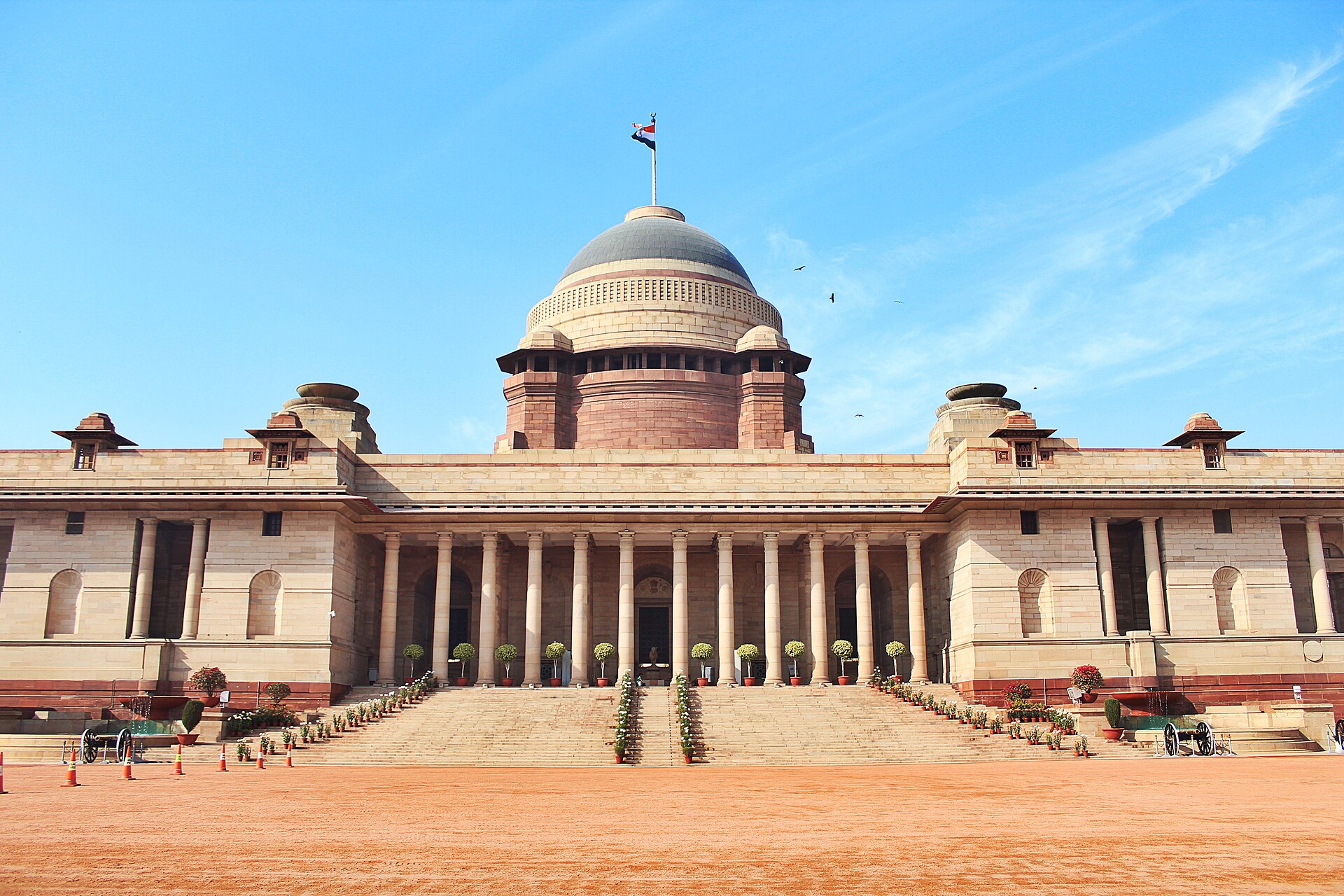
India’s art map has two poles and one seasonal capital. Mumbai has the galleries and the auction houses, Delhi the fair and the state, and Kochi the biennale. The rest are worth knowing. Directory pages are linked where My Biennale has them.
Maharashtra · West coast
The trade’s home: Saffronart, AstaGuru and Pundole’s, Chemould Prescott Road and its peers, Jehangir Art Gallery, and the Ambani cultural center to the north.
Photo: Rutiknatekar, Wikimedia Commons, CC BY-SA 4.0.
Kerala · Malabar Coast
The biennale takes over the warehouses and waterfront of Fort Kochi and Mattancherry, with Aspinwall House as its main venue.
Karnataka
The technology capital has a branch of the National Gallery of Modern Art. No directory page yet.
Rajasthan
A contemporary art space opened in the City Palace at the end of November 2024, by The Art Newspaper’s report. It is the Jaipur Centre for Art, co-founded by Padmanabh Singh and Noelle Kadar. No directory page yet.
Goa
Host city of the Serendipity Arts Festival, whose parent foundation co-organized the Venice pavilion. No directory page yet.
Biennales and fairs
The season runs from November to March, when the weather allows it. Dates are those published by the organizers; where none could be confirmed, the table says so.
| Event | City | Next or most recent | What it is | Directory |
|---|---|---|---|---|
| Kochi-Muziris Biennale | Kochi | 6th edition December 12, 2025–March 31, 2026. 7th to open in December 2027, per the Biennial Foundation. Dates not yet announced | India’s international biennale, founded in 2012 | 6th edition · Series |
| India Art Fair | New Delhi | February 4–7, 2027, per the fair. Last: February 5–8, 2026 | The country’s largest fair; 87 galleries in 2026 | 2026 page · Series |
| Art Mumbai | Mumbai | November 12–15, 2026, Mahalaxmi Racecourse | Modern and contemporary fair, founded in 2023 | Not yet listed |
| Mumbai Gallery Weekend | Mumbai | January 14–17, 2027, per the organizers | Four days of coordinated gallery openings | Not yet listed |
| Serendipity Arts Festival | Panjim, Goa | December 13–20, 2026, per India Art Fair’s events listing. See the festival site | Multidisciplinary arts festival | Not yet listed |
| Ahmedabad Cultural Week | Ahmedabad | October 23–November 1, 2026, per India Art Fair’s events listing | 2nd edition, framed around the climate crisis | Not yet listed |
| Bengal Biennale | Santiniketan and Kolkata | Santiniketan November 25, 2026–January 2, 2027; Kolkata from November 28, per Time Out India | 2nd edition, curated by Chander Haat and Ritika Biswas, across about 20 venues | Not yet listed |
| SITE Jodhpur | Jodhpur | January 29–March 19, 2027, per India Art Fair’s events listing | Listed on the national events calendar; edition not stated | Not yet listed |
| Pune Biennale | Pune | No edition announced | City biennial, listed in the directory without current dates | Series page |
| India Pavilion, Venice Biennale | Venice, Italy | Until November 22, 2026 | The third national pavilion, in the Arsenale | Venice 2026 |
Museums and players
Going there
Plan around the winter. The dates that anchor a first visit fall within 12 weeks of each other: Art Mumbai in mid-November, Mumbai Gallery Weekend from January 14 to 17, and India Art Fair in New Delhi from February 4 to 7. A traveler who wants both poles in one journey should take the January and February pair, with a week between them. Start with the Mumbai and New Delhi pages, and set up the itinerary at My Biennale trips.
Kochi is the exception to every rule. With no biennale this winter, it is a quieter trip, and the next edition is a year or more away. When it returns, the venues are spread along the waterfront of Fort Kochi and Mattancherry. Until the foundation publishes dates, hold off on flights. This winter’s alternatives are the Bengal Biennale, from late November to January 2, and the Serendipity Arts Festival in Panjim, December 13 to 20.
India rewards a second look at the paperwork: check visa requirements well ahead, and confirm fair preview access before booking, since first days are often by invitation. Citizens of more than 175 countries can apply for an e-Visa on the government’s portal; as of October 2026, applications open 120 days before travel and close four days before arrival, and the passport needs six months of validity. Biennales in Asia places Kochi among its regional peers, and Biennale Traveller has the practical pieces on flights, beds and seasons. For tickets, see My Biennale tickets. All of it is free to read.
2027
Sources. The Art Newspaper on the Ravi Varma record, the market, the Gulf conflict and India, India Art Fair, the Venice pavilion, Kochi, KNMA and Srishti Gupta; Art Basel and UBS Art Market Report 2026; India Art Fair; Art Mumbai; Mumbai Gallery Weekend; Kochi Biennale Foundation and its closing report; Business Today on the 360 ONE report; Art Basel Stories; Business Standard on Art Mumbai and the Venice pavilion; Government of India, Expenditure Budget 2026–27 and e-Visa portal; ThePrint and PTI on the national museum and repatriation; ArtReview; ArtAsiaPacific; The News Minute; Biennial Foundation; India Art Fair events listing; Time Out India; Wikipedia on India Art Fair, the Kiran Nadar Museum of Art, the Nita Mukesh Ambani Cultural Centre, the Lalit Kala Akademi and the Ministry of Culture. Directory listings from My Biennale. Not found and so left out: a total value for the Indian art market beyond the auction figures, 2026 results for AstaGuru and Pundole’s, and the current rate of import duty on art. Corrections: contact@biennale.nyc.