The oldest international art exhibition — 130 years of national pavilions, central curators, and the inherited politics of staging the world's contemporary art on the lagoons of an empire that has been over for two centuries.
Above
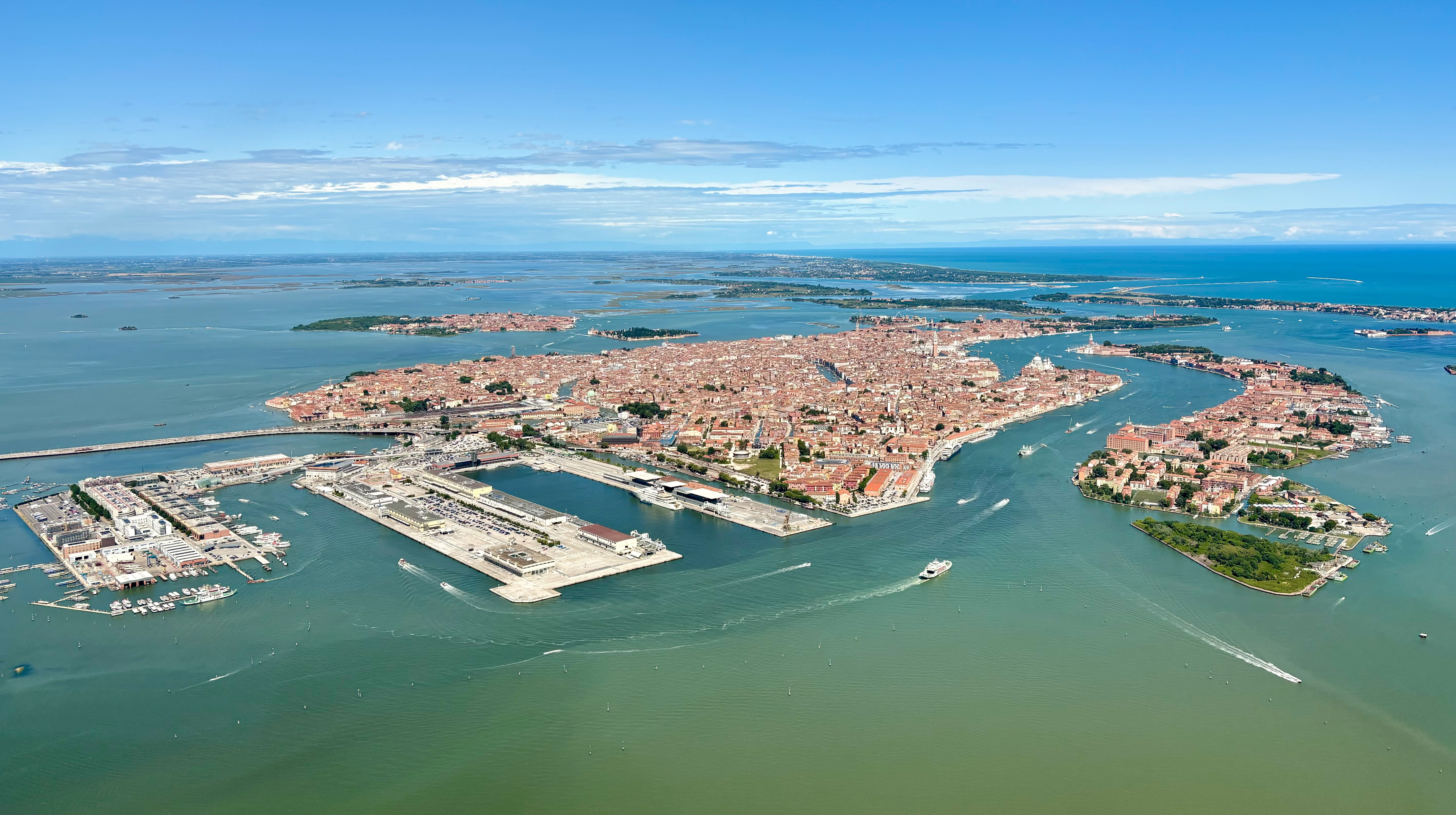
The Arsenale, Venice — the former state shipyard whose Corderie and Artiglierie halls have hosted La Biennale's central international exhibition since the 1980 architecture edition.
· Photograph:
Wikimedia Commons
Editorially independent Biennale's coverage is written without sponsor involvement. This placement is reserved for a future edition partner · sponsorship enquiries
Editorial coverage of the Venice Biennale is independent · Biennale receives no funding from La Biennale di Venezia or its partners
Foreigners
The Lead Essay The 61st Edition, Currently on View
In Minor Keys, after Kouoh
The 61st Biennale opened on 9 May 2026 — Koyo Kouoh's conception, realized by her team after her death. La Biennale's choice not to name a successor is the most consequential institutional decision the institution has made in twenty years.
By the Biennale Editorial Team
For most of its history, La Biennale di Venezia has been organised around a contradiction it has never quite resolved. It is an international exhibition staged in a city whose international weight has been declining for four centuries. It collects the world's contemporary art in a building stock — the Giardini pavilions, the Arsenale's Corderie, the palaces scattered across San Marco and Castello — that was built for an empire, then for a kingdom, then for a republic, and is now maintained by a foundation whose annual budget would not buy two of the works it shows. The 60th International Art Exhibition, which ran from 20 April to 24 November 2024 under the title Stranieri Ovunque — Foreigners Everywhere, did not resolve the contradiction. It looked at it directly for the first time.
Adriano Pedrosa, the Brazilian curator who has been Artistic Director of MASP (the Museu de Arte de São Paulo Assis Chateaubriand) since 2014, was appointed to lead the 60th in December 2022. He was the first Latin American curator and the first artistic director from the Southern Hemisphere in the institution's 129-year history. The Biennale's then-president Roberto Cicutto, in announcing the choice, said almost nothing that explained it. It became clear over the following sixteen months that the appointment was the choice. The title Pedrosa took was borrowed from a long-running series of neon works by the Paris-based collective Claire Fontaine — Foreigners Everywhere, lit in different languages in different installations since 2004. The title is a translation, and a kind of motto, of a slogan from Italian anti-racist activist groups of the early 2000s. Pedrosa used it as a frame for an exhibition that turned the established Biennale grammar inside out: not foreigners as guests at the centre of an art capital, but foreigners as the centre, the host city as a temporarily permeable place.
The Pedrosa exhibition
The central exhibition presented 331 artists, which is a high number for Venice but not unusual. What was unusual was who they were. Pedrosa organised the main exhibition into four formal categories — the "Italians Everywhere" historical section in the Giardini's Padiglione Centrale; sections devoted to the Indigenous, the queer, the outsider, and the self-taught; and a long present-day section in the Arsenale. The historical recovery work was the most consequential. Pedrosa programmed work by twentieth-century Italian artists who had emigrated and were largely forgotten on both sides of their travel — to Argentina, to Brazil, to Uruguay — and placed them alongside Latin American modernists whose national reputations had never crossed the Atlantic. The cumulative argument was that there is no single twentieth-century modernism that Venice has been telling the story of; there are many, and the Biennale has, for a hundred years, told one of them.
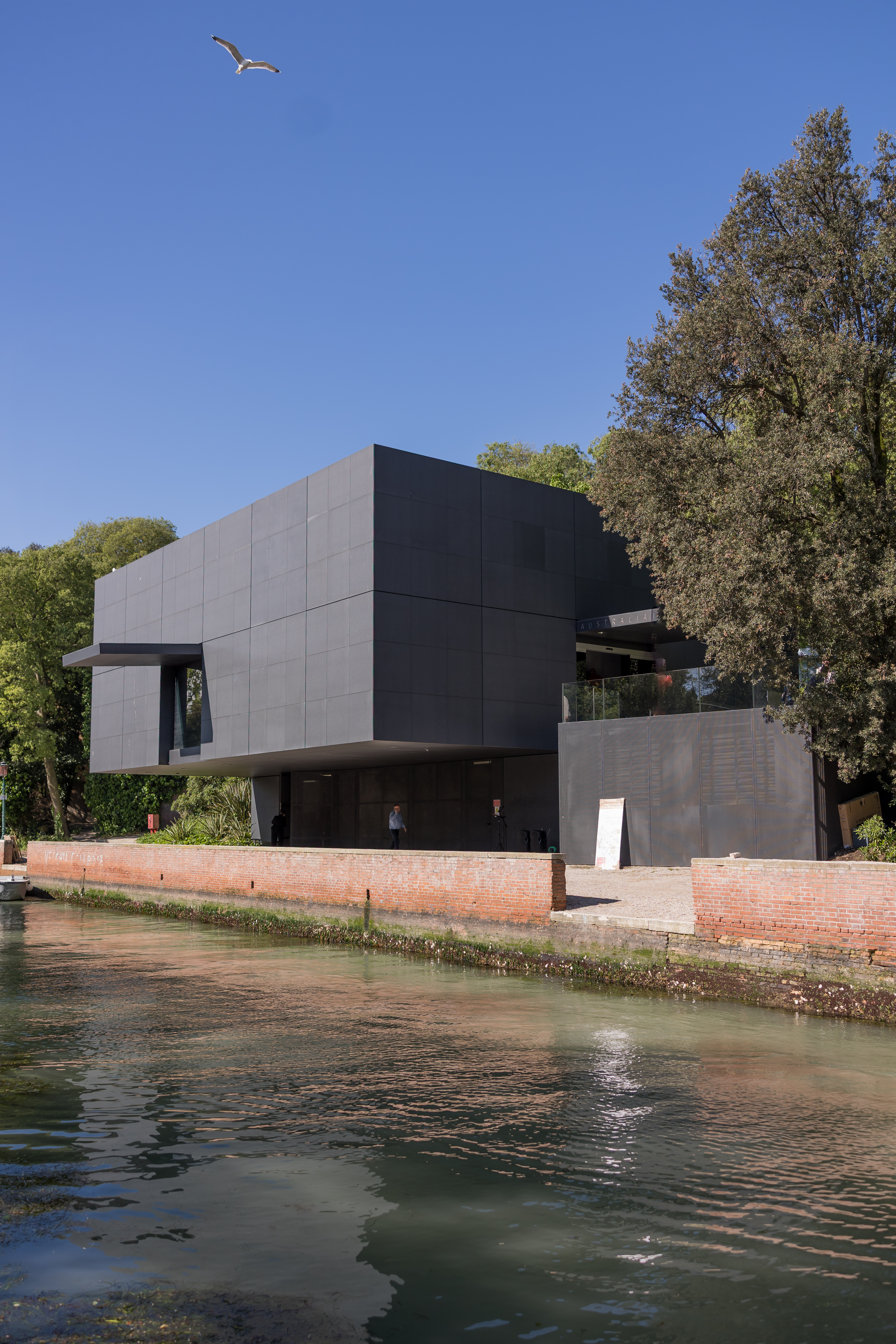
The Golden Lion for Best National Participation went to Australia, for Archie Moore's kith and kin — a chalk-drawn family tree of Moore's Kamilaroi and Bigambul ancestors that covered every wall and the ceiling of the Australian pavilion, with archival documents of Aboriginal deaths in custody arranged on a long table beneath. The Golden Lion for Best Artist went to the Mataaho Collective, four Māori women whose woven installation Takapau opened the central exhibition. Both prizes were, in the judgement of every serious reviewer of the edition, the right ones.
Above
The Australian Pavilion at the Giardini della Biennale — Denton Corker Marshall's black-clad 2015 pavilion, one of twenty-nine permanent national pavilions, built in the Giardini between 1907 and 1995.
· Photograph:
Wikimedia Commons · CC BY-SA 4.0
The national pavilions, and a different scoreboard
The national pavilions have been the part of the Biennale that resists most successfully every Artistic Director's framing. The pavilion system was built up gradually after Belgium's first pavilion in 1907 and was the principal mechanism by which Venice survived two world wars and a Cold War as a working international exhibition. The pavilions are commissioned independently of the Artistic Director, by national agencies of varying competence and political weather. In 2024 they were, by the consensus of the field, the strongest collective showing in a decade. The German pavilion under Çağla Ilk and the artists Yael Bartana, Ersan Mondtag, and three sound artists generated genuine argument. The Polish pavilion's withdrawal of its government-selected exhibition and reinstallation of an unauthorised Ukrainian project by Open Group made political news. The Holy See pavilion, installed in the women's prison on Giudecca and curated by Chiara Parisi and Bruno Racine, was the most discussed object in the city.
The pavilions are commissioned independently of the Artistic Director, by national agencies of varying competence and political weather. In 2024 they were, by the consensus of the field, the strongest collective showing in a decade.
— On the 60th edition
The 61st, and the loss
In December 2024 the Biennale's new president, Pietrangelo Buttafuoco — appointed in February of that year to succeed Cicutto — announced that the 61st International Art Exhibition would be directed by Koyo Kouoh, the Cameroonian curator who had since 2019 been Executive Director and Chief Curator of the Zeitz Museum of Contemporary Art Africa in Cape Town. Kouoh would have been the first Black African curator to lead the Biennale, and only the second woman after Bice Curiger (2011) to direct the main exhibition in the post-1990 reformatted institution. Her programme at Zeitz MOCAA — particularly the long-running When We See Us: A Century of Black Figuration in Painting (2022) — had positioned her as the obvious next artistic director for any biennial committed to expanding what its curatorial intelligence looked like.
Kouoh died unexpectedly in Basel on 10 May 2025, eleven days before she was scheduled to announce the title of her edition at La Biennale's offices in Venice. She was 57. The loss was the most consequential to the field in living memory.
The institution's answer
The institution did the hardest of three things it could have done. The succession could have defaulted to a senior European curator and the edition would have continued by other means. It could have elevated one of Kouoh's collaborators alone and the edition would have become, in a different way, a tribute. Or it could refuse to name a successor at all — and let the team Kouoh had assembled realize the exhibition she had conceived. La Biennale, in the summer of 2025, chose the third route.
The title Kouoh had been preparing to make public — In Minor Keys — was announced on 21 May 2025, eleven days after her death. The phrase was hers; the conception was hers; the participating artist list of 110 was set before her death. The advisors named to realize the project — Gabe Beckhurst Feijoo, Marie Hélène Pereira, and Rasha Salti — were the figures who had been working with Kouoh on the artist list and conceptual framework since late 2024. Editor-in-Chief Siddhartha Mitter and research assistant Rory Tsapayi rounded out the working team. La Biennale has confirmed that the Golden Lion for Lifetime Achievement will not be awarded for the 2026 edition, as Kouoh was unable to finalise the selection before her death. What the team has done in the year since Kouoh's death has been the work of bringing the exhibition into the world rather than re-conceiving it.
In Minor Keys opened on 9 May 2026 and will run to 22 November. The institutional context in which it opens is unsettled: ten days before the opening, on 30 April 2026, the International Jury of the 61st edition resigned en bloc — La Biennale di Venezia confirmed the resignations on the same day. Days later, on 4 May, the Islamic Republic of Iran announced it would not participate. The edition opens, in other words, into a year of withdrawals — institutional and national — that the exhibition itself was not designed to anticipate. The themes Kouoh had been developing at Zeitz MOCAA since 2019 — historical inheritance, resistance, the garden as a figure for survival, the present as a condition art is asked to register — meet the present on terms harder than she could have foreseen.
What Pedrosa proved in 2024 is that the Biennale, when it commits to a single curatorial intelligence, can still rise to the institution it was meant to be. What Kouoh's team has proved in 2026 is that a Biennale can also be sustained — and made coherent — by those who knew a curator's mind well enough to deliver her exhibition after she could no longer do so. Whether either is a replicable institutional model is a different question. For the present, the edition is open.
Current Coverage The 61st Edition, on view
Reviews and dispatches from In Minor Keys
Opening-week coverage and ongoing reviews of the 61st Venice Biennale. Updated as the edition runs.
A fuller current-coverage reading list — opening-week reviews and critical responses to In Minor Keys — will be added as published pieces are verified against their sources.
Critical Perspective The Pavilion Question
The pavilions, and what they keep doing
A century after the first national pavilion went up in the Giardini, the system remains both the Biennale's greatest political liability and its most useful editorial fact.
By the Biennale Editorial Team
The national pavilion system is one of those institutional inheritances that everybody agrees is indefensible in principle and nobody can quite see how to dismantle in practice. The Belgian pavilion went up in the Giardini in 1907; the British, the Bavarian (later German), the Hungarian, and the French followed before the First World War. The American, the Israeli, the Brazilian, and the Austrian pavilions came after the Second. By 1995 there were twenty-nine permanent national pavilions, built in the Giardini between 1907 and 1995, with the remaining national participations distributed among the Arsenale's collateral spaces and the palazzi scattered through Castello, Cannaregio, and Dorsoduro.
The conceptual case against the pavilions is straightforward and has been made for thirty years. They organise contemporary art around a category — the nation — that everyone who works in contemporary art has spent their professional life arguing against. They distribute attention by political and economic weight rather than by curatorial argument. They subject participating artists to the politics of their national appointment committee, which is, in most countries most of the time, a politics of cultural diplomacy rather than of art. And in years when a particular state is in the news for the wrong reasons, the pavilion becomes a symbol independent of what is inside it. The 2022 Russian pavilion — closed by its own artists and curators — and the 2024 Polish reinstallation are the most legible recent cases. The 2024 Israeli pavilion's closure of its planned exhibition until "a ceasefire and hostage agreement" was reached is the most discussed.
The case for the pavilions, against all of this, is that they are the only mechanism by which contemporary art's attention is forced to extend beyond the small group of institutions whose curators tend to do the choosing. The 88 national participations in the 2024 edition included countries — Albania, Benin, Ethiopia, Nicaragua, Sao Tome and Principe, Tanzania, Timor-Leste — that would otherwise never appear in the official frame of an international biennial. The pavilions are, in their inefficiency and their political weather, the most demonstrably democratic mechanism the contemporary art world has. They are the part of Venice that the central exhibition can be measured against rather than the other way around.
The question this raises, which the institution has not been willing to ask out loud, is whether the curatorial authority that the Artistic Director is given to shape the central exhibition could also be given to shape the pavilion programme — to require, for instance, that pavilions respond to a structural condition rather than a national curatorial committee's drift. In 2024 Pedrosa came closer to this than any of his predecessors, by inviting national participations to respond to Foreigners Everywhere as a condition rather than a suggestion. Most ignored it. Some did not, and the ones that did not produced the strongest pavilions. There is a reform argument here, and it has been made too quietly. The next president of La Biennale, whoever that is when the term changes, will inherit it.
The pavilions, then, are both the part of Venice that most deserves the structural critique it gets, and the part that most justifies the institution's continuing claim on the international attention. To dismantle them is to lose a working mechanism that no other biennial has been able to replicate. To reform them — to give them a stronger curatorial relationship to the central exhibition — is to do the work the institution has been postponing since at least 1995.
The Institutional Spine
Defining moments
Five episodes from 130 years. Not a chronicle, but the moments at which the institution became different from what it had been before.
18951st Edition
The founding under Selvatico
The first International Art Exhibition of the City of Venice opened on 30 April 1895 in the Padiglione Centrale of the newly created Giardini, marking the silver wedding anniversary of King Umberto I and Queen Margherita. The mayor Riccardo Selvatico had pressed the idea for four years; the chief curator was Antonio Fradeletto. Sixteen nations and 516 artists participated; 224,000 visitors attended over six months. The model — biennial, international, mixed national and central curation — has remained recognisably the same for 130 years.
Sources: La Biennale di Venezia archives · ASAC (Archivio Storico delle Arti Contemporanee)
19077th Edition
The first national pavilion — Belgium
The Belgian pavilion, designed by Léon Sneyers, opened in the Giardini in April 1907, inaugurating the national pavilion system that has defined Venice ever since. The British, German, Hungarian, and French pavilions followed by 1912; the Russian and Spanish before the First World War. The structure proved durable through two world wars, the Cold War, and the post-1989 reorganisation of Europe.
Sources: The Pavilions of Venice (Marsilio); ASAC
194824th Edition
Peggy Guggenheim, and the post-war return
The 24th Biennale, the first after the war, opened in the summer of 1948 with the Greek Pavilion empty — Greece was in the middle of its civil war — and offered to Peggy Guggenheim for the presentation of her personal collection. Pollock, Rothko, Ernst, Mondrian, Picasso, Brancusi and Giacometti were shown in Venice for what was, for many Italian visitors, the first time. The collection became the seed of the museum she would install at Palazzo Venier dei Leoni on the Grand Canal.
Sources: ASAC; Peggy Guggenheim Collection archives; La Biennale di Venezia: A History 1895–1968 (Alloway)
196834th Edition
The protests, and the end of the prize system
The 1968 Biennale opened on 22 June in the context of European-wide student protests. The opening was interrupted; artists withdrew their work in protest at the institution's commercial focus and its prize system; the police occupied the Giardini. The Biennale subsequently abolished the formal prizes (they were restored only in 1986 in a different form) and rewrote its founding statute, declaring the institution autonomous from the Italian state.
Sources: ASAC; Corriere della Sera archive, June 1968
19801st Architecture
The Architecture Biennale begins
The first International Architecture Exhibition opened in October 1980 in the Arsenale's newly restored Corderie, curated by Paolo Portoghesi as The Presence of the Past. The exhibition's "Strada Novissima" — a street of post-modernist façades by twenty international architects — became one of the foundational moments in the codification of post-modernism. The Architecture Biennale has run on the alternating years to the Art Biennale ever since.
Sources: La Biennale di Venezia archives; The Presence of the Past catalogue, 1980
202460th Edition
Pedrosa's Foreigners Everywhere
Adriano Pedrosa, Artistic Director of MASP since 2014, became the first Latin American and first Southern Hemisphere curator to lead the Biennale. His central exhibition centred Indigenous, queer, outsider, and self-taught artists, and recovered a body of twentieth-century Italian-emigrant modernism. Golden Lion for Best National Participation: Australia (Archie Moore). Golden Lion for Best Artist: Mataaho Collective. The edition was both critically successful and politically argued over.
Sources: La Biennale di Venezia; The Art Newspaper, April–November 2024
People in the 60th & 61st
The figures shaping Foreigners Everywhere, and what follows
Artistic Director, 60th edition
Adriano Pedrosa
Brazilian curator, born 1965. Artistic Director of the Museu de Arte de São Paulo Assis Chateaubriand (MASP) since 2014, where he has overseen the long-running Histórias series of exhibitions on Afro-Atlantic, Indigenous, and queer histories. The first Latin American and first Southern Hemisphere artistic director in the Venice Biennale's history.
Cameroonian-Swiss curator, 1967–2025. Founded RAW Material Company in Dakar in 2008; Executive Director and Chief Curator of Zeitz Museum of Contemporary Art Africa (Zeitz MOCAA), Cape Town, from 2019. Her programme reshaped the institution's curatorial intelligence — notably the long-running When We See Us: A Century of Black Figuration in Painting. Appointed Artistic Director of the 61st Venice Biennale in December 2024. Died unexpectedly in Basel on 10 May 2025, eleven days before she was scheduled to announce her exhibition title.
Italian writer, journalist, and broadcaster, appointed President of La Biennale di Venezia in February 2024 to succeed Roberto Cicutto. Buttafuoco's appointment by the Meloni government was politically argued at the time of his confirmation; his subsequent oversight of the 60th edition under Pedrosa, and the December 2024 appointment of Koyo Kouoh for the 61st, has been less contested.
Paris-based collective founded in 2004 by Fulvia Carnevale and James Thornhill, working under a borrowed Parisian-stationery name and the conceit of a "ready-made artist." The Foreigners Everywhere / Stranieri Ovunque neon series — produced in dozens of languages since 2004 — gave Pedrosa his title. The phrase itself is taken from an anti-racist slogan of Italian activist groups of the early 2000s.
San Marco · Castello · Cannaregio · Dorsoduro · Giudecca — see the official venue guide for individual addresses.
For the Visitor
Visiting the Venice Biennale
Dates, venues, tickets, and how to arrive at the Giardini and the Arsenale.
When the Biennale runs
La Biennale di Venezia operates a two-year cycle, alternating between the International Art Exhibition in even-numbered years and the International Architecture Exhibition in odd-numbered years. The 61st Art Biennale — the edition currently on view — runs from 9 May to 22 November 2026, with preview days on 6, 7 and 8 May. The architecture cycle returns in 2027.
The opening week in May is the press, preview, and vernissage season; the exhibition then operates continuously through the Venetian summer and into the autumn closing on the third Sunday of November. The Carnival and the Festa del Redentore (third Sunday of July) fall within the Biennale's run and shape the city's accommodation patterns.
Where the Biennale happens
The central exhibition is staged across two anchor sites — the Giardini della Biennale in the Castello sestiere and the Arsenale — together with national and collateral participations sited in palazzi across San Marco, Castello, Cannaregio, Dorsoduro, and the islands of Giudecca and San Giorgio Maggiore. The mainland site at Forte Marghera holds additional collateral pavilions.
The Giardini holds the Padiglione Centrale and the longstanding national pavilions (the United States, France, Britain, Germany, the Nordic Pavilion, the Venice Pavilion, and roughly twenty-five others) built between 1907 and the 1990s. The Arsenale — the former state shipyard — holds the central thematic exhibition in the Corderie and Artiglierie halls, plus the more recently constructed national pavilions of countries that arrived after Giardini land was fully allocated.
Tickets & opening hours
The standard single-access ticket for the 61st edition is €30 (€20 reduced for over-65s and Venice residents; €16 for students and visitors under 26). A single ticket admits one entry to the Giardini and one to the Arsenale — on the same day or on two non-consecutive days.
Multi-day passes are widely used by serious visitors: the 3-day pass is €40 and the 7-day weekly pass is €50. The full-season Permanent pass is €80 (€50 for Venice residents).
Opening hours are 11 AM – 7 PM from 9 May to 27 September (last admission 6:45 PM); from 29 September the hours shift to 10 AM – 6 PM through to the close. The Arsenale extends to 8 PM on Fridays and Saturdays through 26 September. The exhibition is closed on Mondays with the seasonal exceptions of 11 May, 1 June, 7 September, and 16 November 2026. Current details are published at labiennale.org.
Getting to Venice & the venues
By air — Venice Marco Polo Airport (VCE) at Tessera is the principal arrival, around 13 kilometres from central Venice; Treviso Airport (TSF) serves some low-cost carriers. From Marco Polo, the Alilaguna waterbus (Blue or Red line) runs directly to the Giardini stop in roughly an hour and a quarter (€18 one-way; the ACTV city-transport pass does not cover Alilaguna).
By rail — Venezia Santa Lucia is the main mainland station; high-speed services from Milan, Florence, Rome, Bologna and Verona terminate there.
To the venues — The principal vaporetto routes for the Biennale are Line 1 (which serves the Arsenale and Giardini stops in sequence from Piazzale Roma and Santa Lucia along the Grand Canal) and the faster Line 2 and Line 4.1 (which also serve the Giardini). For visitors planning two days or more across both sites, the 48-hour ACTV pass (€35) is the conventional buy.
When to visit during a season
Opening week (early May) is the press, vernissage, and preview season — densely scheduled, expensive on accommodation, and the only time the international art world is reliably in the city in concentration. The opening days are typically reserved for invited press and professionals; public access begins on the official opening Saturday.
June and July are warm and increasingly crowded with general tourism overlaid on Biennale visitors. September and October are the practical sweet spot — the Venetian heat has eased, the long-term visitor flow has thinned, and the exhibition's collateral programme is still in full operation. The closing weeks of November carry the autumn light the city is photographed in.
Allow two full days to walk the Giardini and the Arsenale unhurriedly; a serious visit covering the principal collateral palazzi extends to three or four. The longer multi-day passes are calibrated for this.
Where to stay
The historic centre is divided into six sestieri; the relevant ones for the Biennale are Castello (the sestiere containing both the Giardini and the Arsenale — the shortest walks to the venues but the smallest accommodation inventory), San Marco and Dorsoduro (the cultural-tourism heart, more hotel choice at higher prices), and Cannaregio (closer to Santa Lucia, traditionally better value).
Many serious Biennale visitors base themselves on the mainland in Mestre or Marghera, where mid-range chain hotels are abundant, and use the regular train or bus into Venezia Santa Lucia or Piazzale Roma as part of the daily rhythm. The Tourist Board's official directory of registered properties is at veneziaunica.it.
Practical details confirmed against La Biennale di Venezia's published 2026 information pages, the Alilaguna and ACTV (Venice public transport) timetables, and the Venezia Unica city services directory. Hours and the Monday-closure exception dates will be updated if revised by the Biennale.
My Biennale
Carry the Biennale with you
Save this biennale to your circuit, follow its artists as their pages grow, and sync every opening and closing to your own calendar on the companion app.
Four essay-length features on the structures, prizes, materials and breakthrough moments around the Venice Biennale. Each is a self-contained argument; together they sit alongside the defining-moments grid as the editorial spine of this page.
Cultural analysis
Architecture of Power: how the national pavilions shape global art politics
To understand the Venice Biennale is to understand the geography of power inscribed in its very landscape. Walking through the Giardini is not just navigating an exhibition space — it is traversing a century-old map of global influence, where architecture becomes diplomacy and real estate reflects realpolitik. The pavilion system, unique among major art exhibitions, began in 1907 when Belgium constructed the first national pavilion in the Giardini. What followed was a decades-long land grab that mirrors the geopolitical dynamics of the twentieth century: the prime real estate near the entrance belongs to the early adopters — Britain (1909), Germany (1909), France (1912). The United States, a latecomer in 1930, compensated for its tardiness with sheer architectural ambition, building a neoclassical temple that dominates its corner of the gardens.
This frozen choreography of national power becomes more revealing when one considers what is missing. China, India, and most of Africa hold no permanent pavilion in the Giardini; their participations must rent space in the Arsenale or in palazzi scattered through Castello, Cannaregio and Dorsoduro. The architecture of inclusion and exclusion speaks plainly about whose culture was deemed worthy of permanent representation in the early twentieth century. The pavilion system also creates a unique curatorial structure: unlike other biennales where a single artistic director shapes the entire exhibition, Venice operates as a confederation of mini-exhibitions, each reflecting national artistic policies and politics.
This has produced some of the Biennale's most memorable moments. Hans Haacke's 1993 destruction of the German Pavilion's floor exposed its 1938 Nazi-era renovations; Sophie Calle's 2007 French Pavilion transformed it into a hotel; Sarah Lucas's 2015 British Pavilion painted itself yellow and seemed to glow with irreverent energy. The 2019 Lithuanian Pavilion — Sun & Sea (Marina) by Rugilė Barzdžiukaitė, Vaiva Grainytė and Lina Lapelytė — staged a working beach inside an Arsenale rope-store and won the Golden Lion for Best National Participation that year. The pavilion system also perpetuates inequalities. Wealthy nations can afford star architects and elaborate installations; others struggle with basic exhibition costs. The Nordic Pavilion, shared by Sweden, Norway and Finland, offers one model of collaboration; the Central Pavilion's group section provides space for countries without permanent venues.
As we move deeper into the twenty-first century, the pavilion system increasingly resembles an anachronism in a globalised, post-national art world. Yet perhaps that is precisely what makes it valuable. In an era of international art fairs and global gallery empires, the pavilions offer a different model: art as cultural diplomacy, aesthetic expression tied to national identity, creativity shaped by — and sometimes struggling against — political frameworks. The real genius of Venice's pavilion system may be how it makes visible what other exhibitions hide: that all art is political, all exhibitions are exercises in power, and all cultural spaces encode hierarchies. By literalising these dynamics in brick and mortar, the Biennale forces us to confront questions other exhibitions can avoid. Who gets permanent space in the global cultural conversation? Whose art represents a nation? What does it mean to make national art in a transnational world?
Sources: La Biennale di Venezia archives · Marco Mulazzani, The Pavilions of Venice (Marsilio) · Hans Haacke, GERMANIA documentation, 1993 · La Biennale Architecture archives, 2019.
Artist profile
The Weight of Water: Simone Leigh's sovereign journey from Venice to the world
When Simone Leigh's bronze figures occupied the United States Pavilion at the 59th Venice Biennale in 2022, something shifted in the gravitational field of contemporary art. Leigh became the first Black woman ever to represent the United States at Venice. Her exhibition, Sovereignty, was curated by Eva Respini, Barbara Lee Chief Curator at the Institute of Contemporary Art / Boston, and commissioned by the ICA Boston. The pavilion's neoclassical facade, modelled in 1930 on Thomas Jefferson's Monticello, was reskinned by Leigh with a thatched roof drawn from Cameroonian and Mali architectural traditions — a literal recoding of one of the Giardini's most ideologically loaded buildings.
Born in Chicago in 1967 to Jamaican parents, Leigh studied philosophy at Earlham College before turning to ceramics; she has built her practice around the historical erasure of Black women's intellectual traditions, using clay, bronze and raffia to assemble what she has called “critical fabulations” — speculative forms built from suppressed pasts. Her 2018 Hugo Boss Prize at the Guggenheim and her 2019 High Line commission Brick House — a sixteen-foot bronze bust — had already made the case for her at monumental scale.
The Venice pavilion built on that argument. The exhibition opened with Satellite, a twenty-four-foot bronze figure that combined a Hadza skeleton-dress, a Dogon house post and a satellite-dish form; visitors looked up, always up, reversing the typical power dynamics of museum viewing. Inside, a sequence of large-scale ceramic and bronze figures — including Cupboard, Sentinel, Sphinx, and a new monumental ceramic, Last Garment, modelled on a nineteenth-century Jamaican photograph of a laundress — moved through chambers each more architecturally insistent than the last. The pavilion won the Golden Lion for Best National Participation in April 2022; Leigh herself received the Golden Lion for Best Artist in the international exhibition for the bronze Brick House that opened Cecilia Alemani's The Milk of Dreams.
The exhibition has had a long institutional afterlife. After Venice it travelled to the ICA Boston as a major US survey (2023), then to the Hirshhorn (2023–24) and the California African American Museum / LACMA. Major acquisitions followed — at the Metropolitan Museum, MoMA, the Smithsonian, the Tate. The Venice presentation cracked open possibilities for how contemporary art thinks about representation, monumentality and cultural sovereignty: not as inherited categories, but as forms that can be remade.
Sources: La Biennale di Venezia, 59th International Art Exhibition records · ICA Boston, Sovereignty exhibition documentation (2022–23) · Hirshhorn Museum, Simone Leigh, 2023 · The Art Newspaper, April 2022 Golden Lion announcement.
Prize history
The Golden Lions: Venice's contested crowns
The Golden Lion (Leone d'Oro), Venice's highest honour, carries weight beyond mere recognition — it can transform careers, redirect art-historical narratives, and ignite fierce debate. Established in 1938 and named after Venice's symbolic guardian, the award has evolved from a single prize into a sequence of categories: Best National Participation, Best Artist in the International Exhibition, Special Mentions, and the Golden Lion for Lifetime Achievement. The formal prize system was abolished in 1968 in the wake of that year's protests and only restored in 1986 in its current form.
Early awards favoured European and American men, with women and non-Western artists largely excluded. The 1990s marked a slow opening, accelerated dramatically in the twenty-first century as the Biennale grappled with its colonial inheritance. Recent recipients indicate the shift. In 2022, the United States Pavilion under Simone Leigh and curator Eva Respini won Best National Participation; Leigh herself won Best Artist for Brick House. In 2024, the Golden Lion for Best National Participation went to Australia for Archie Moore's kith and kin — a chalk-drawn family tree of Moore's Kamilaroi and Bigambul ancestors that covered every wall and the ceiling of the Australian Pavilion. The Golden Lion for Best Artist in the central exhibition went to the Mataaho Collective, the four-woman Māori weaving practice whose installation Takapau opened Adriano Pedrosa's Foreigners Everywhere. The Lifetime Achievement Lions of 2024 went to the Brazilian artist Anna Maria Maiolino and the Turkish-French artist Nil Yalter.
The Lion has become the single most legible Venice metric for the outside world. Curators dispute its weight; artists rarely refuse it. The 2026 edition, conceived by Koyo Kouoh as In Minor Keys, will not award the Golden Lion for Lifetime Achievement — La Biennale has confirmed that Kouoh was unable to finalise the selection before her death in May 2025, and the prize is being held for a future edition. The institutional argument the prize stages — about who, in any given two years, the field decides has changed something fundamental — continues regardless.
Sources: La Biennale di Venezia, prizes archive · The Art Newspaper, Venice prize coverage, 2022–2024 · La Biennale di Venezia, 2026 edition announcements, May 2025.
Material history
The Art of Light: Murano glass and Venice's material heritage
While contemporary art fills Venice's pavilions, the city's own artistic tradition continues to evolve on the island of Murano, where glassmaking has flourished for over seven hundred years. Glass furnaces were relocated to the island in 1291 by decree of the Venetian Republic — officially to reduce fire risk in the city's wooden palazzi, in practice to consolidate the trade in a place where the secrets of the masters could be guarded. For centuries the maestri were forbidden from leaving the Republic on penalty of imprisonment; their craft remained central to Venice's economy and cultural identity.
The relationship between Murano glass and contemporary art creates a recurring dialogue during Biennale season. Across the past three editions, contemporary artists — among them Ai Weiwei, Cerith Wyn Evans, Carlos Garaicoa and Jaume Plensa — have collaborated with Murano furnaces through the long-running Glasstress exhibition, mounted by Berengo Studio at Palazzo Franchetti in parallel to the Biennale. The collaborations have proved instructive in a way that the rest of the Biennale rarely is: working with molten glass demands a surrender of control alien to most contemporary practice. The material has its own logic. It teaches a humility to artists otherwise accustomed to commanding their media.
The chandeliers of Murano represent the apotheosis of Venetian decorative arts — gravity-defying sculptures of light that transformed palazzi and theatres across Europe from the seventeenth century onwards. During the Biennale, contemporary artists frequently respond to that baroque tradition. Visiting the furnaces of Murano during the exhibition season offers a reminder that Venice has always been a site of artistic innovation. Watching a maestro shape molten glass with tools largely unchanged since the Renaissance, one understands that tradition and innovation are not opposites but dance partners.
Sources: Comune di Venezia, Murano historical records · Glasstress exhibition archive, Berengo Studio, 2009–2024 · Marino Folin and Rosa Barovier Mentasti, Glass Throughout Time, Skira.
Essential Reading
For further work
La Biennale di Venezia: A History 1895–1968
Lawrence Alloway · Faber, 1968
The standard English-language history of the institution's first seven decades. Foundational.
Biennials and Beyond — Exhibitions That Made Art History 1962–2002
Bruce Altshuler · Phaidon
The reference. Multiple chapters on Venice, including the 1968 protests and the 1993 Aperto.
Stranieri Ovunque — Foreigners Everywhere
Adriano Pedrosa, ed. · 2024 catalogue, La Biennale di Venezia
The full catalogue of the 60th edition, including Pedrosa's curatorial essay and the historical recovery sections.
The Pavilions of Venice
Marco Mulazzani · Marsilio
The architectural history of every national pavilion in the Giardini. Out of print but available second-hand.
Show Time: The 50 Most Influential Exhibitions of Contemporary Art
Jens Hoffmann, ed. · Thames & Hudson
Includes chapters on Szeemann's Aperto 1980 and Hou Hanru's 2007 Chinese pavilion.
When We See Us — A Century of Black Figuration in Painting
Koyo Kouoh, ed. · Zeitz MOCAA, 2022
The Zeitz MOCAA catalogue that established the curatorial argument Kouoh was bringing to Venice.
Images, attribution & rights
Photographs are reproduced from Wikimedia Commons under the Creative Commons licences stated in each caption. Credit and a link to the source file are provided in every case. If you are the photographer of an image used here and wish to discuss its use, please write to rights@biennale.com; we will respond promptly.
Editorial content is original and credited to the Biennale Editorial Team. No image, essay, or other editorial element on this page may be reproduced commercially without written permission. Quotation under fair dealing or fair use for review, scholarship, or news reporting is welcomed and need not be cleared.