Skip to content

Biennale  /  Event Supplements  /  Dakar Biennale 2026  /  Dakar Art Scene

Dak’Art profile · Dakar city page · Free to read · Updated October 6, 2026

Dakar Biennale · Dakar · November 19 to December 19, 2026

Dakar Art Scene

Dakar has argued about art and the state since 1960. Here is the argument in order: a president’s legend, a museum turned court, a courthouse turned exhibition hall, and the places artists built for themselves.

The Village des Arts, Dakar, during the 2000 biennale
The Village des Arts, Dakar, during the 2000 biennale. Photo: Iolanda Pensa, Wikimedia Commons, CC BY-SA 3.0.

The lists   The Artists & Designers  ·  Dak’Art: history and essays  ·  Dak’Art on My Biennale  ·  Dakar on My Biennale

Sixty years, 1960 to 2018

What the State Gave and Took

The Supreme Court of Senegal sits in a museum. The building on the Dakar seafront was inaugurated on March 31, 1966 as the Musée dynamique, for the first Festival mondial des arts nègres. It hung Picasso in 1972. In 1988 President Abdou Diouf gave it to the judiciary, and the court has occupied it since 1990. The old courthouse at Cap Manuel, closed since 1992, has been the biennale’s main exhibition site since 2016. A museum became a court. A courthouse became an exhibition hall, for one month every two years. The 16th Dakar Biennale (Dak’Art) opens in it on November 19, 2026.

That exchange is the short version of Dakar’s art history. For sixty years the state here has been patron and landlord by turns, and now and then bailiff. Artists have answered each turn with something of their own: a squat, a courtyard, and the OFF, the biennale’s independent fringe programme, which now runs past 400 entries. The scene a visitor meets in 2026 is what that argument has left standing.

The quarter that never was

One number follows the early years everywhere. Léopold Sédar Senghor, president from 1960 to the last day of 1980, is said to have given a quarter of the national budget to culture. A 2005 review of the standard book on the period states it flatly. David Murphy writes more carefully of estimates of up to 25 percent. Koyo Kouoh, in a 2024 podcast, used another number, 40 percent, for education and culture together.

The source is Senghor himself. In 1989 he credited the state with more than 25 percent of its budget for education and culture, two things in one phrase, as the art historian Joshua I. Cohen quotes him. Cohen then read the budgets in the Archives nationales du Sénégal. His 2021 article in African Arts finds that education and culture combined usually sat between 18 and 22 percent, and passed 25 percent only in 1977 to 1978 and in 1979 to 1980. Education took most of it. Culture alone came to 0.26 to 0.78 percent of the annual budget between 1966 and 1970, and stayed under 0.7 percent even in the years when the combined heading crossed the quarter. A footnote adds that much of the culture money came from France.

So the legend is a rounding by the man it flatters, with education dropped in the retelling. The policy was not hollow: Cohen still counts Senegal among the best-funded arts systems in Africa in those decades. What the archive changes is the scale. The culture line behind a national art school, a tapestry manufacture, a new theatre and a museum was less than one franc in a hundred. The state’s attention was large. Its cheque was small. Much of what follows happened in the gap. (Elizabeth Harney’s In Senghor’s Shadow, the standard history, could not be consulted for this guide.)

A school with two rooms

The national art school traces itself to 1959, when Senghor asked the painter Iba N’Diaye to help create an École des Arts. Papa Ibra Tall came home in 1960 and, by Bonhams’s account, co-chaired a Section de Recherches Plastiques Nègres there with Pierre Lods. The two rooms disagreed. N’Diaye opposed the idea that African artists should unlearn technique, and kept what one survey calls a critical distance from the official Négritude aesthetic.

The painters Bonhams names beside Tall, Bacary Dième and Ibou Diouf among them, are the École de Dakar, and its emblem is wool. Le Soleil dates the creation of the national tapestry manufacture at Thiès to December 4, 1966, with Tall as first director; Bonhams gives 1965. The manufacture turns 60 on December 4, 2026, during the biennale (see What to See).

April 1966

The festival ran from April 1 to 24, 1966. More than 2,500 artists, musicians, performers and writers came from 30 independent African countries and from the diaspora. Duke Ellington, Langston Hughes, Josephine Baker, Aimé Césaire and Wole Soyinka were in the city. Guinea, under Sékou Touré, stayed away. The stated aim, Cédric Vincent reports, was the defence and illustration of Négritude.

L’Art nègre gathered more than 700 objects from collections around the world in the new museum. Tendances et confrontations showed more than 200 contemporary works; it was begun under Tall and finished by N’Diaye, the school’s two rooms sharing one hang. The bill belongs in the record too. The Senegalese state paid most of it, UNESCO funded the colloquium, France paid heavily for the exhibition of traditional art, and the festival lost 158 million CFA francs, by Murphy’s account.

The museum on the seafront

Who paid for the Musée dynamique is disputed. Murphy and Vincent say UNESCO, Lucia Allais says the Senegalese state alone. Chagall came in 1971, Picasso in 1972, Soulages in 1974. Then its uses changed with the presidents. From 1977 to 1982 Senghor lent the building to a dance school, Mudra-Afrique. It reopened as a museum in 1984. In 1988 Diouf handed it to the courts; Murphy and Vincent write that its director was led out of the building by armed soldiers. In 1996 Diouf announced its return to the culture ministry, a decision that was never carried out. Collectors told Joanna Grabski that the state’s collection of 1960s and 1970s works deteriorated there. The building’s status in 2026 was not found.

The courtyard answers

The reply came from artists. The Laboratoire Agit’Art was founded in Dakar in 1974, by Tate’s account, by the artist Issa Samb, the filmmaker Djibril Diop Mambéty, the painter El Hadji Sy and the playwright Youssoupha Dione. Wikipedia’s entry on Samb gives 1973, and the artist Mansour Ciss Kanakassy names a different set of founders and ties the founding to the death in custody of Omar Blondin Diop and the crushing of the student movement. The sources agree on the method (street performance, happenings, manifestos) and on the target, which was Négritude as the prevailing philosophy. Its address was Samb’s own courtyard in the centre of the city.

In 1977 Sy and other artists moved into an abandoned military camp in central Dakar and made it the first Village des Arts. Selebe Yoon, his gallery, gives that year; Sunu Journal gives 1980. In September 1983 troops attacked the site and evicted the residents, in Harney’s account as a reviewer relays it; Sunu Journal says the army bulldozed it. Yacouba Konaté reads the closure as a sign of the cultural contraction under Diouf. Within five years the artists had lost their village and the public its museum. After 1984, painters left out of a Galerie nationale exhibition organised their own Salon national des artistes plasticiens. Konaté counts those salons among the pressures that produced a biennale.

Clean and be clean

One more movement belongs to these years, and its date is unsettled: Set Setal, Wolof for clean and be clean. A 2021 article in Urban Studies dates this popular ecology movement to 1988. Another scholar writes of the late 1980s. Harney, through the same review, places its murals in 1988 to 1989, and 1990 also appears. Only excerpts of the two articles could be read, so the conflict stands. The standard text is Mamadou Diouf’s 1992 essay on the murals and the writing of history.

October 1989

In October 1989 Diouf announced a Biennial of Arts and Literature; Ugochukwu-Smooth Nzewi’s dissertation gives the day as October 7. No text of a decree was found. The first edition, in December 1990, was devoted to literature. The first art edition followed in 1992, and in 1996 Dak’Art repositioned itself as a pan-African event.

Read against the decade before it, the 1989 decision looks like a settlement. The state had closed a village and a museum. It gave back a calendar. The run of editions is on the Dak’Art history page, in People and on My Biennale.

Bronze, then a round museum

The Monument de la Renaissance africaine, 52 metres of bronze on the Mamelles hill, was inaugurated on April 3, 2010 by its own site’s dating, or on April 4 by a ministry page. The Musée des Civilisations noires opened on December 6, 2018, built with a Chinese donation of some 20 billion CFA francs (30.5 million euros), as the culture minister told AFP. AidData records handover of the building in January 2016, so it waited almost three years to open. When it did, it had no permanent collection of its own and a brief to receive returned works, JusticeInfo reported. On September 24, 2026 the 16th biennale was launched there. A museum built to be filled by restitution, and a biennale in a borrowed courthouse: the state still supplies the walls. The contents are made elsewhere.

“The Museum of Black Civilizations is not an ethnographic museum, it is not an anthropological museum, it is not a chromatic museum - it is a museum of insubordination”

— Hamady Bocoum, first director of the Musée des Civilisations noires, in JusticeInfo, February 15, 2022
0.26–0.78%of the annual budget for culture alone, 1966 to 1970 (Cohen, 2021)
2,500+participants in the 1966 festival (Murphy, 2016)
158 millionCFA francs lost by the 1966 festival (Murphy, 2016)
20 billionCFA francs from China for the Musée des Civilisations noires (AFP, 2018)

Reverse-glass painting

Signature First, Sky Last

The word suwer is the Wolof form of the French sous-verre, under glass, the Smithsonian Libraries note. The painter works on the back of a pane and in reverse order, signature and details first and the background last, so that the picture is read through the glass that protects it. The technique reached Senegal by way of North Africa. Piasa traces it from eighteenth-century Central Europe to the Maghreb coast and puts its Senegalese start at the end of the nineteenth century; the Smithsonian says the early twentieth, on Tunisian models. The first subjects were Islamic: scenes from the Qur’an, the life of Cheikh Amadou Bamba, Al-Buraq. Then came what one curator’s note lists as portraits, musicians, wrestlers and Mami Wata, and the drianké, the elegant, heavily jewelled woman.

Elsewhere the printed image replaced the trade. In Senegal, Piasa observes, it persisted. The Smithsonian supplies the less comfortable half: a local art for local buyers before the 1960s became largely a commercial art for tourists. (A colonial ban on religious images in 1908, often told as part of this story, was not found in any source and is left out.)

The masters, and one woman

Le Quotidien names the masters as Babacar Lô, Gora Mbengue, Mor Guèye, Mamadou Gaye and Serigne Ndiaye. Mbengue (1931–1988) is the one in museums abroad: his Al-Buraq of 1975 is in the Brooklyn Museum. Anta Germaine Gaye, a trained art teacher, is in the paper’s telling the only woman among them. She scratches the paint, collages fabric and uses laminated glass so that the pictures stop shattering. Her line on the medium: “La peinture sous verre est comme le griot, elle exalte et elle narre” (in English: painting under glass is like the griot, it exalts and it narrates). The 15th biennale, in 2024, made her its honoured artist.

Where to see it, and who uses it now

In Dakar, sous-verre studios are among the workshops of the Village des Arts, and an Atelier Fer & Verre, the name of Gaye’s studio, is on the Partcours members’ list. In Saint-Louis, the Musée du Sous-verre, one site of the Musée de la Photographie, tells the story through works by Gora Mbengue, Mbida and Gaye, according to its listing; the page would not load, so confirm before travelling. No citable source was found for dealers in the markets. For prices there is one benchmark, Piasa’s sale of the Renaudeau collection on March 28, 2023: estimates of 1,500 to 2,000 euros for three plates by Mbengue and 3,000 to 5,000 euros for an anonymous Kaaba of 1950. Results were not found.

The medium’s present tense is Fally Sene Sow, born in 1989, who builds street scenes on glass from paint and collage: magazine pages, cloth scraps and chewing-gum foil gathered at the Colobane market across the street from his home.

Nineteen names

Who to Know Before You Go

Eleven artists from Senegal, or listed with it, are on the official list for 2026. Their pages on the organizer’s site were empty on October 6, 2026, so these notes rest on galleries and the press. Diptyk counts El Hadji Sy among the careers kept off international radar that the artistic director, Morad Montazami, favours. The full list of 54 artists and 21 designers is on The Artists & Designers. The last eight names below are not in the selection.

Born 1954, Dakar · painter

El Hadji Sy

In the 2026 selection. In the 1970s he painted with his feet: “My foot became a brush with which to paint a systematization of the trace of the body.” (to Julia Grosse, quoted in Africa Is a Country, June 8, 2022). Documenta 14 in 2017. Selebe Yoon represents him.

Born 1970, Dakar · painter, photographer, filmmaker

Cheikh Ndiaye

In the 2026 selection. Lives between Dakar and Prague. His subject is ordinary and informal architecture, cinema façades above all. Venice Biennale 2015, according to Galerie Cécile Fakhoury.

Born 1976, Dakar · painter, video artist, animator

Ibrahima Niang “Piniang”

In the 2026 selection. His subject is urban disorder. Shown at Dak’Art 2008 and at the Bronx Museum in 2010, per the US Art in Embassies programme.

Born 1971, Dakar · self-taught painter

Ibrahima Cissé “Déb’s”

In the 2026 selection. Acrylic, pastel, charcoal and chalk on heavy jute or kraft paper; urban scenes, says Hoop Galerie.

Born 1983, Nouakchott · film, photography, installation

Hamedine Kane

In the 2026 selection, listed as Mauritania/Senegal/Belgium. Co-founded L’École des Mutants in 2018. He treats borders as places of passage and transformation, in his gallery’s wording.

Born 1983, Pikine · painter and sculptor

Mbaye Babacar Diouf

In the 2026 selection. The Pearls of Light, a 700 kg bronze Tijani rosary of 100 beads, was commissioned for the IFAN museum in 2021. Source: 50 Golborne.

Born 1987, Sidi Bougou, Mbour · painter

Aliou Diack

In the 2026 selection. From a farming family. He sows pigment on canvas as he sows seed, the Goethe-Institut’s profile says. OH Gallery lists him.

Born 1988, Dakar · drawing, painting, collage

Serigne Ibrahima Dieye

In the 2026 selection. Large square canvases peopled with hybrid animals. Cairo Biennale, 2019, per Galerie Cécile Fakhoury.

Born 1996, Lausanne · photographer

Eva Diallo

In the 2026 selection, listed as Senegal/Switzerland. Lives in Dakar. Bolol, in chapters since 2018, follows the overland migration routes taken by her cousins, per her gallery.

Born 1997, Angoulême region · sculptor

Carla Gueye

In the 2026 selection, listed as Senegal/France. Lime, sand and clay. Corps Immergés, made with women oyster farmers in Senegal, won the COAL Art and Ecology Prize 2024, per Tiwani Contemporary.

Birth year not found · outsider artist, Médina

Pape Diop

In the 2026 selection, presented by Mamadou Boye Diallo. He lives in the Médina and works on walls, pavements and plywood with found materials, painting the marabout Serigne Touba and figures half human, half animal, per Yataal Art’s Partcours page.

1935–2016, Dakar · sculptor

Ousmane Sow

A physiotherapist who turned to sculpture; his Nuba wrestlers were shown at the Centre culturel français in Dakar in 1987, by Wikipedia’s account. Seventy-five of his figures stood on the Pont des Arts in Paris in 1999, Le Figaro recalled.

1961–2017 · sculptor in iron

Ndary Lô

The only artist to win the Grand Prix twice: alone in 2002, for the welded-iron walking figures of La longue marche du changement, and shared in 2008, per the biennale’s history.

Born 1969, Dakar · painter, draughtsman, sculptor

Soly Cissé

Hybrid human and animal figures, per Black Liquid Art. On the biennale: “It is important to ensure the continuity of this event, if it ceased to exist, it would entail negative consequences for contemporary art in Senegal and West Africa.” (to Artnet News, August 3, 2023).

Born 1985, Kaffrine · painter

Alioune Diagne

He calls his manner figuro-abstro: figures built from small abstract signs. He represented Senegal in its first pavilion at the Venice Biennale, in 2024, per Templon, his gallery since 2022.

Born 1989, Dakar · mixed media on glass

Fally Sene Sow

Street scenes in paint and collage on glass. In 2024 Galerie Christophe Person, of Paris, showed him in the OFF at the Jardin tropical, Afrique Magazine reported.

Birth year not found · installation

Caroline Guèye

Trained in astrophysics; ECOWAS prize at Dak’Art 2022, per Villa Albertine. She represents Senegal at the 2026 Venice Biennale with Wurus, Wolof for gold, DakArtNews reports. Unconfirmed

The people who run the scene, in People
Biennale

“RAW was an alternative to everything else that was there, and it was also the place to look at art not in a contemplative way but rather in an engaged, integral way as an agent that shapes society.”

— Koyo Kouoh, founder of RAW Material Company, in 1-54, November 15, 2022

Institutions and independent spaces

The Rooms Artists Built

For its first half century the Dakar scene had state buildings and artists’ occupations, and little between them. Most of the middle was built after 2008, and its founders’ list is largely a list of women: Koyo Kouoh, Marion Louisgrand Sylla, Aïssa Dione, Cécile Fakhoury, Océane Harati, Jennifer Houdrouge.

In 2026 these spaces supply the official event. Two of the biennale’s four curators come out of them: Delphine Lopez has directed Galerie Cécile Fakhoury in Dakar since 2018, and Fatima Bintou Rassoul Sy was RAW’s director of programmes from 2023 to 2026. The independent scene used to be the state event’s fringe. Now it is also its staff. No source read for this guide comments on a serving gallery director sitting on the official curatorial team. Status lines are as of October 6, 2026.

Founded 2008 · Zone B

RAW Material Company

  • A centre for art, knowledge and society founded by Koyo Kouoh; a permanent space since 2011, with the RAW Académie and a residency.
  • Kouoh died on May 10, 2025. No named director was found for October 2026; Sy leaves in December for the Musée des Civilisations noires.
  • Autumn programme not found.

Since 1998 · airport road

Village des Arts

  • Housing built for the Chinese workers of the Stade Léopold Sédar Senghor, granted to artists by the culture ministry in 1998. It has 52 or 53 studios.
  • Its site lists the 2026 biennale as a coming event and names no exhibition.

Founded 2010 · Médina

Yataal Art

  • Mamadou Boye Diallo’s association. Its museum is the street: more than 100 street artists have painted the Médina’s façades, its Partcours page says.
  • Diallo presents Pape Diop in the official selection. Guided walks for 2026 not found.

Founded 2019

Black Rock Senegal

  • Kehinde Wiley’s residency, with stays of one to three months. It is not a gallery and publishes no address; no public event for the biennale was found.

The companies, and the school

Two firms stand behind much of this. Eiffage Sénégal has backed Partcours from its first edition; its Maison Eiffage, inaugurated on March 31, 2022, houses its collection. The Fondation Sonatel paid for the renovation of the Village des Arts gallery in 2019. The state’s part is the school, renamed the École Nationale des Arts et Métiers de la Culture in January 2022.

Addresses, hours and current shows, in What to See
Biennale

“we want to protect the spirit of freedom that goes together with improvisation and amateurism, but also with freshness and sympathy.”

— Mauro Petroni, ceramicist and coordinator of the OFF, in Contemporary And, May 2, 2014

The OFF

The Fringe That Outgrew the Centre

The OFF is the name for everything that opens in the biennale’s month without being chosen by it. It is the part of Dak’Art that the city made for itself, and it began as an objection. In 1996, when the official selection was first reserved for Africa, an exhibition called Amour interdit gathered artists of 14 nationalities at the Nety Guy residence in the Almadies, the OFF’s 2022 brochure recalls. The organizer says a technical commission for such exhibitions was created in 2002. The ceramicist Mauro Petroni, from Lucca and in Dakar since 1983, coordinated the programme from that edition. He credits two secretaries general, Rémi Sagna and Ousseynou Wade, with giving private initiatives a label and an institutional status. The state event, in other words, adopted its own counter-exhibition. Then the counter-exhibition outgrew it.

OFF exhibitions or registrations by edition. Sources: Biennale de Dakar (OFF guide 2014, OFF brochure 2022, OFF page); Artforum; ArtPulse; Afrique Magazine; APS. Checked October 6, 2026.
YearEditionOFF count
19962ndOne exhibition, Amour interdit
20004thAbout 50
20046th130
201411thMore than 270 registrations (OFF guide); 266 exhibitions (Artforum)
201813thMore than 320
202214th403 registered
202415thMore than 450
202616thMore than 400 expected; list not published

Petroni’s own summary, to DakArtNews in October 2024: “We started with about thirty spaces, and it grew to 450 spaces.” For 2026, APS reports more than 400 expected. No count was found for 2016.

Who pays

The biennale does not. The 2026 conditions leave each promoter to find a venue, meet every cost and do their own publicity. In return they get an OFF pennant and a place in the guide and on the map. No registration fee is mentioned. Eiffage has covered the OFF’s communication, by the OFF’s own guide. The one published cost figure is old: Konaté put the average budget of 160 OFF shows at 5,000 euros, around 2009. No sales total for any OFF has been published.

The argument about it

Is 450 too many? Petroni has come close to saying so. In the 2014 interview he allowed that the mechanism had grown rusty and that most venues were poor places to show. The critic Nevdon Jamgochian, on the 2018 edition, went further: “The ‘Off’ sites were the meat of the Biennale.” He added that the official map missed half of what he saw. Both follow from the history above. An open register with no budget and no jury is what a city builds when it has learned not to wait for the ministry. Its unevenness is the price of its independence.

Who coordinates the OFF in 2026 was not found; Petroni himself is in the official design section. The 2026 rules are in The Exhibitions.

Market and collecting

Who Buys, and What It Costs

Dakar had collectors before it had galleries of the present kind. Joanna Grabski’s 2008 study names a politician buying since the 1970s, an accountant since 1982 and an architect since 1985, with holdings of 20 to more than 200 works. The best documented is the businessman Bassam Chaitou: more than 225 works from 1997, over 130 of them shown at the IFAN museum in 2007, and 325 pieces by a 2014 market report’s count. Amadou Diaw, founder of Senegal’s first business school, told Diptyk in 2020 that he had about 500 works; in 2017 he founded the Musée de la Photographie in Saint-Louis. The biennale’s own steering committee is chaired by Abdoulaye Diop, whom the organizer listed in 2023 as a former minister of state and a collector. No account of his collection was found.

Who buys now is a matter of testimony. The painter Modou Dieng Yacine, to DakArtNews in May 2025: “Art hasn’t yet reached the level of music or cinema here.” No press source gave price ranges for work bought in Dakar galleries or studios.

Fairs and the saleroom

Dakar galleries sell abroad through the 1-54 fairs: OH Gallery showed Soly Cissé in London in 2025, by his Artsy record. At auction, the figures on record belong to the dead. Papa Ibra Tall’s Vin Noir (1964) made US$168,825 with premium at Bonhams in New York on May 2, 2019. Ousmane Sow’s record is 528,695 euros with fees, set in Paris in November 2014 for figures from his Zulu series, Le Figaro reported; at Christie’s in 2009 only two of his ten lots had sold. Results for Alioune Diagne, Soly Cissé and Ndary Lô were not found.

Buying, and the paper nobody could confirm

A sale in the OFF is a private contract between the buyer and the artist or promoter. Ask for an invoice and a signed certificate of authenticity. What could not be established is the export procedure for a newly made work. The legal base is law no. 71-12 of 1971 on historic monuments, which bars the export of classified objects and of objects of national interest and gives the state a right of pre-emption. One 2026 policy paper says an exit authorisation must be obtained when the rules on cultural property require it. Unconfirmed Which office issues that authorisation for contemporary art, what it costs and how long it takes: no official page was found. Ask the gallery to confirm with the Direction du Patrimoine culturel before shipping. Anything old needs clearance by law.

Policy and money, 2025 and 2026

The Same Thin Slice

The ministry

In 2024 culture sat inside a ministry of Youth, Sports and Culture, as APS reported then. It now shares one with crafts and tourism, under Alpha Thiam since June 2026. The 2026 budget is 28.9 billion CFA francs in commitment authorisations, for culture, crafts and tourism together. Le Soleil reported a drop of 1.8 percent against 2025; a government note speaks of a spectacular rise. The two may not measure the same perimeter.

Set the figure beside the whole state budget for 2026, 7,433.9 billion CFA francs. The arithmetic is this guide’s own and not a published figure: 28.9 billion is about 0.39 percent, for three sectors. Senghor’s culture line, in Cohen’s archive, ran from 0.26 to 0.78 percent. The legend says the state once gave art a quarter. At the two ends of the record, the share is of the same order, under a poet and under his successors. What has changed is who fills the gap. The biennale’s own 2026 budget was not found; Host City has what is known.

The artist-status law, correctly dated

The law on the status of the artist and of culture professionals is often dated 2023. It is law no. 2021-09, voted by the National Assembly on December 30, 2020 and promulgated on March 13, 2021; the number is given by UNESCO’s Dakar office. It creates a right to social protection for people who work in culture. What happened in 2023 was smaller: on August 11, five draft application texts were put to the profession. Whether they have been signed and published was not established as of October 6, 2026.

One percent

An older law is quieter still. The Director of Arts, Hugues Diaz, in October 2025: “Il y a une loi dont on ne parle plus et qui est d’une importance capitale. C’est la loi 6802 du 4 janvier 1968.” (in English: there is a law nobody talks about any more and it is of capital importance; it is law 68-02 of January 4, 1968), Le Quotidien reported. It requires public building projects above a threshold to spend 1 percent of the works on artistic decoration. Diaz could say little about how far it is applied now, and asked for it to be updated.

Restitution

Four days after the Sarr-Savoy report reached the French president in November 2018, the culture minister Abdou Latif Coulibaly told AFP: “If you have 10,000 pieces (of art identified from Senegal), we want to have the 10,000” (AFP, November 27, 2018). The Musée des Civilisations noires opened nine days later. One object has come. The sabre attributed to El Hadj Omar Tall was handed over at the museum on November 17, 2019, and a French law of December 24, 2020 made the transfer definitive. As of February 2022 it was the only piece France had returned to Senegal, and no other official request had followed, JusticeInfo reported.

On May 9, 2026 France promulgated a framework law, no. 2026-351, which allows restitutions without a separate act of Parliament for each object. No formal Senegalese request under it was found. The museum built to receive returns is, for now, a biennale venue.

The city as an art map

Up the Peninsula, District by District

The art map runs up the peninsula from its southern tip. The old centre holds the official venues and most of the galleries; the OFF goes wherever someone has a wall. What to See turns them into routes, and My Biennale’s Dakar page keeps the directory.

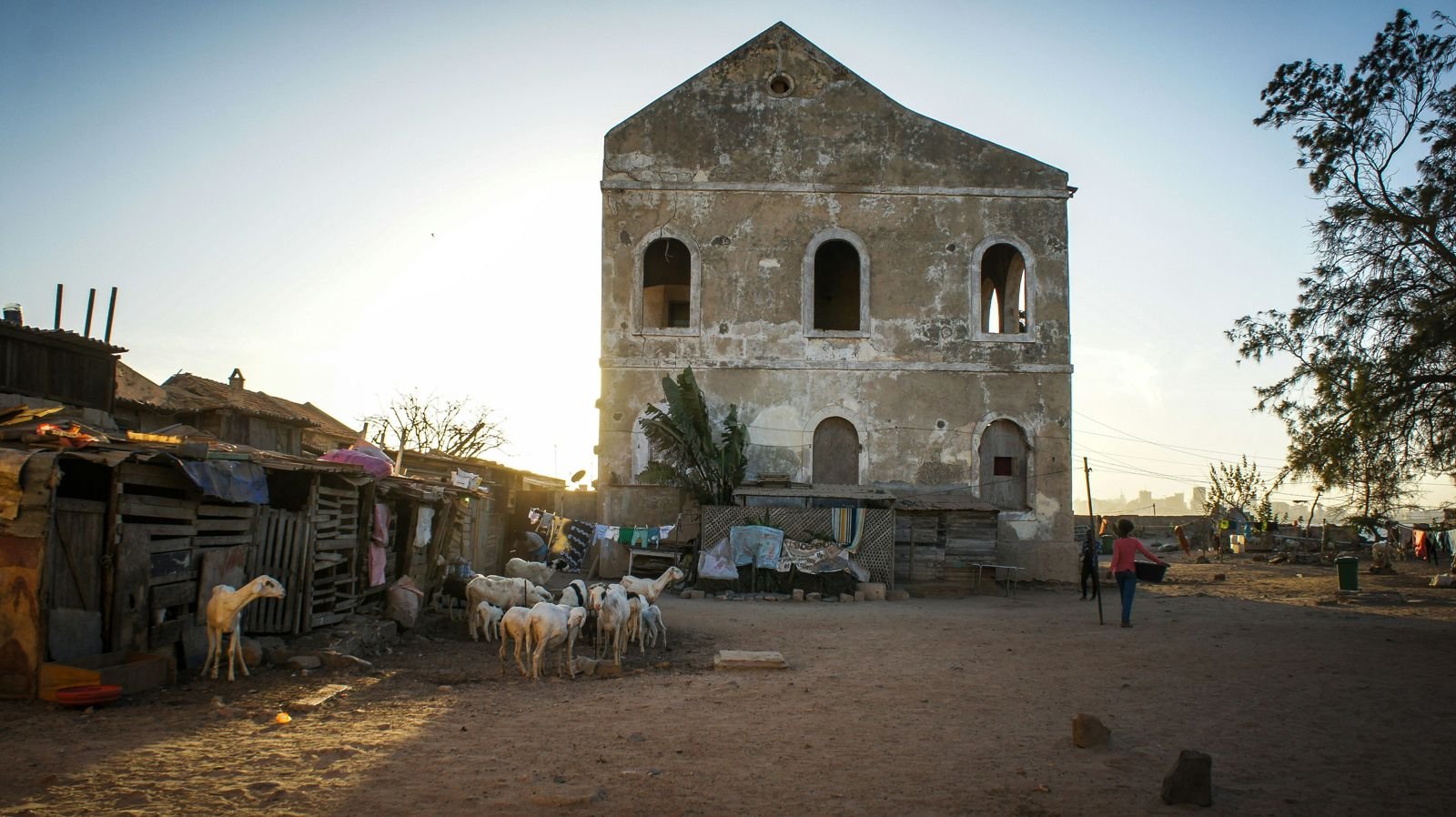
A house on Gorée, with the towers of the Plateau behind
A house on Gorée, with the towers of the Plateau behind. Photo: Vince Gx, Unsplash.

The old centre

Plateau and Cap Manuel

  • Ancien Palais de Justice at the southern tip: the biennale’s main site.
  • Musée des Civilisations noires, next to the Grand Théâtre national; Galerie nationale and the biennale’s office at 19 avenue Hassan II.
  • Selebe Yoon, OH Gallery, Hoop Galerie, Agence Trames, Musée Théodore Monod.

West of the centre

Médina and the Corniche Ouest

  • Galerie Atiss, Rue 23 at Boulevard Martin Luther King.
  • Yataal Art, Rue 25 x 2 bis, and the painted façades.
  • The former Musée dynamique, now the Supreme Court, on the seafront.

The middle of the city

Colobane, Sicap, Zone B, Liberté

  • RAW Material Company, Zone B, Villa 2A.
  • Kër Thiossane, Sicap Liberté; the national art school, Liberté 6 extension.
  • Colobane: Fally Sene Sow’s studio, opposite the market.

The western point

Ouakam, Mamelles, Almadies, Ngor

  • Monument de la Renaissance africaine on the Mamelles hill.
  • Atelier Céramiques Almadies, Petroni’s studio. Mermoz, on the way: Galerie Arte.
  • Artists rent studios on Ngor island, Artforum noted in 2024.

North

Yoff and the old airport road

  • Village des Arts, between the Stade Léopold Sédar Senghor and the CICES fairground.

Island and suburbs

Gorée and the banlieue

  • Gorée: several OFF exhibitions each edition. See What to See.
  • Pikine and Guédiawaye: OFF sites in 2022. Rufisque: Centre culturel Maurice Guèye.

Beyond Dakar

Thiès, Saint-Louis, Petite Côte

  • Thiès: the tapestry manufacture.
  • Saint-Louis: the photography museum and the Musée du Sous-verre; an OFF centre since 2010.

Not placed: Black Rock Senegal, Loman Art House and the Maison Ousmane Sow. No address was found for them.

Reading list

Ten Books and Papers

Each title was checked against a publisher, library or repository page.

Sources. The main sources are Joshua I. Cohen in African Arts, David Murphy and Yacouba Konaté for the history; Piasa and Le Quotidien for sous-verre; the organizer’s 2026 selection, Partcours and the galleries’ own sites for artists and spaces; the OFF brochure of 2022 and the 2026 conditions for the OFF; Joanna Grabski, Bonhams and Le Figaro for the market; APS and JusticeInfo for policy. All pages were read on October 6, 2026. Biennale is independent and not affiliated with the organizer; confirm dates and hours with the organizer and each venue. Corrections: contact@biennale.nyc.