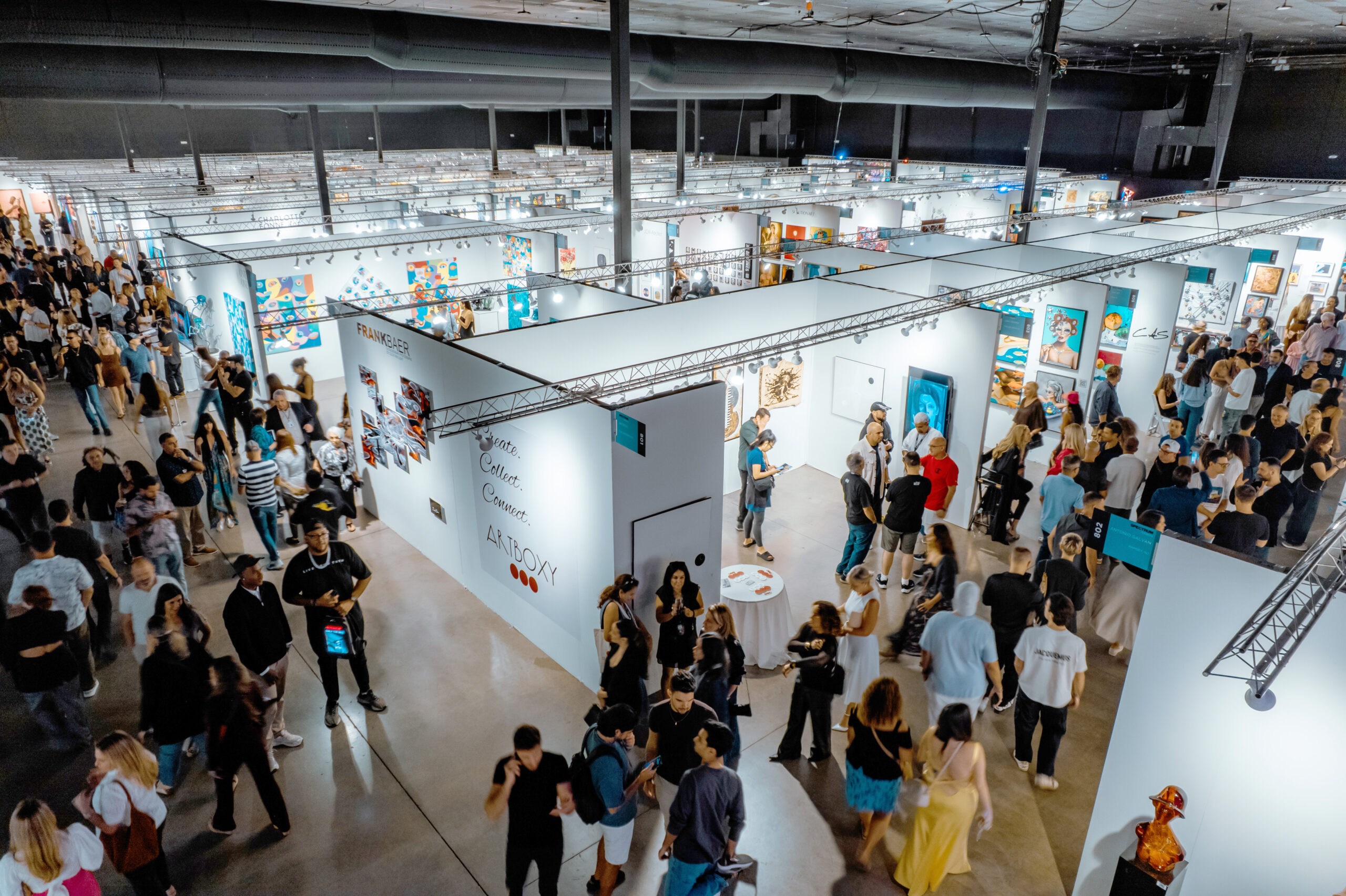
The main fair got smaller on purpose and said so. Art Basel’s September 29 announcement names 272 exhibitors from more than 40 countries and territories, against the 283 that took part in 2025, on a convention center footprint that The Art Newspaper puts at about 12% smaller.
The fair calls this refinement. The arithmetic is plainer: the main sector has lost 22 exhibitors, there are four hospitality plazas where there were five, and the largest galleries are now spread across the floor instead of grouped together. For a visitor, the consequence is a hall that can be read in a day. For a dealer, it is a shorter list to be on.
The 272 is a sum with an overlap. Art Basel counts 254 galleries across four sectors, Galleries, Nova, Positions, and Survey, and 22 in Zero 10; four of those 22 also show in Galleries. The full exhibitor list is sorted by sector.
Artnet News reads the cut against a year in which galleries and collectors have taken a more measured approach to fairs. Bridget Finn, in her third edition as director, described the same mood to Artnet from the other side: exhibitors, she said, are planning more carefully what they want to project about their businesses and their artists.
Galleries: 204
The main sector falls from 226 exhibitors to 204. Art Basel describes it as museum-caliber Modern and postwar work alongside contemporary practice, and the names at the top have not moved: Gagosian, Hauser & Wirth, David Zwirner, White Cube, Pace Gallery, Lisson Gallery, Paula Cooper Gallery, Galerie Max Hetzler, Thaddaeus Ropac, Sprüth Magers, Esther Schipper, and Xavier Hufkens are all in the release.
Two galleries enter the sector for the first time, Arario Gallery of Seoul and Galería Casado Santapau of Madrid. Art Basel also describes El Apartamento as the first Cuban gallery in the main Galleries sector. Seven return to the main sector after time away: Pilar Corrias, DC Moore Gallery, Alison Jacques, Kerlin Gallery, Modern Art, Edward Tyler Nahem, and Mariane Ibrahim. Selma Feriani Gallery is back after eight years.
The departures are the more telling list. Kurimanzutto, Night Gallery, and Gallery Wendi Norris are not returning, according to both Artnet News and The Art Newspaper. Artnet adds Goodman Gallery and Sperone Westwater, which has closed; The Art Newspaper adds Commonwealth and Council, Gallery Hyundai, Pippy Houldsworth Gallery, and Richard Saltoun.
The fair remains a hemispheric one. More than two-thirds of its galleries have spaces in the Americas, by Art Basel’s count. Brazil supplies the third-largest national contingent, 23 galleries have Los Angeles spaces, and Chicago sends five.
South Florida’s list has movement in it. Fredric Snitzer Gallery, David Castillo, Gavlak, and Nina Johnson return. Spinello Projects makes its Galleries debut after showing in Nova, and Piero Atchugarry Gallery advances to the main sector. El Apartamento opened a Miami space in late 2025; Eric Firestone Gallery has expanded to West Palm Beach.
The audience is institutional too. Art Basel expects its largest contingent of museum groups of any of its 2026 shows, and two acquisition prizes return: the Legacy Purchase Prize and the CPGA-Villa Albertine Prize.
Nova, Positions, Survey, Kabinett
- Nova, 20 galleries, each showing new work by up to three artists. Sargent’s Daughters and Marinaro are among the newcomers.
- Positions, 12 solo projects by emerging artists. First-timers named by Art Basel include Galeria Nora Fisch, TERN Gallery, Storage, King’s Leap, Harkawik, Moskowitz Bayse, and Sea View.
- Survey, 16 historically focused presentations by 18 galleries, devoted to practices the fair considers due renewed attention. New here: de Sousa Galería, Galería de las Misiones, Omer Tiroche Gallery, The Bonnier Gallery, Andrew Reed Gallery, Fort Gansevoort, and Mariposa.
- Kabinett, 28 focused presentations set inside exhibitors’ own booths: one artist, one historical body of work, or one theme at a time.
More than 30 exhibitors are new to the fair, most of them in these smaller sectors, and five countries appear for the first time: The Bahamas, Estonia, Georgia, Ghana, and Hungary. The smaller sectors were trimmed as well. Surface counts four fewer booths in Positions and two fewer each in Nova and Survey.
Zero 10: Generation
The sector for art of the digital era, introduced in Miami Beach in 2025, returns as an exhibition titled Generation: 19 projects from 22 galleries and platforms. It is curated by Karen Archey, head of the curatorial department at the Kunstsammlung Nordrhein-Westfalen, with Eli Scheinman, who curated the first edition, as co-curator and strategic advisor. Artists named so far include Jon Rafman, Refik Anadol, Random International, Sarah Meyohas, Studio Drift, LoVid, Harm van den Dorpel, Daniel Rozin, and Yatreda.
Archey’s title carries two meanings, by her account in the release: generation as the computational process that produces images, and a new generation of artists working through the systems of the digital age. Art Basel has also made its first appointment to run the sector, hiring Nicole Sales Giles, formerly of Christie’s, as Global Head of Zero 10 in September.
What Is Missing: Meridians
Meridians, the sector for large-scale work, appears nowhere in the 2026 announcement. Surface states that it has been discontinued; no second outlet has confirmed that wording, and Art Basel’s release is silent. Unconfirmed Its last outing, in 2025, was a sixth edition of 19 works curated by Yasmil Raymond. Several tourism listings still show Meridians for 2026; they appear to be carrying last year’s copy.
Outside the Hall
Scale has moved outdoors. The Turrell Art Foundation and Art Basel, supported by Pace Gallery, will unveil what the release calls a significant new body of work by James Turrell, sited outside. In Collins Park, the Public Art Fund presents Between Tides, a set of artist-designed ping-pong tables meant to be played on, curated by Gabriela López Dena, with Moko Fukuyama, Ilana Harris-Babou, Las Hermanas Iglesias, Carlos H. Matos, Amalia Pica, and SUPERFLEX.
The Art Basel Awards, presented with BOSS, hold their second Awards Night on Thursday, December 3, at New World Center, where the Gold Awardees are named from a field of 33 Medalists in nine categories. The Conversations program will give one full day to art and sport; its speakers have not been published. Not yet announced
Finn, Archey, and who else runs the week


_T639156614685305403.jpg)