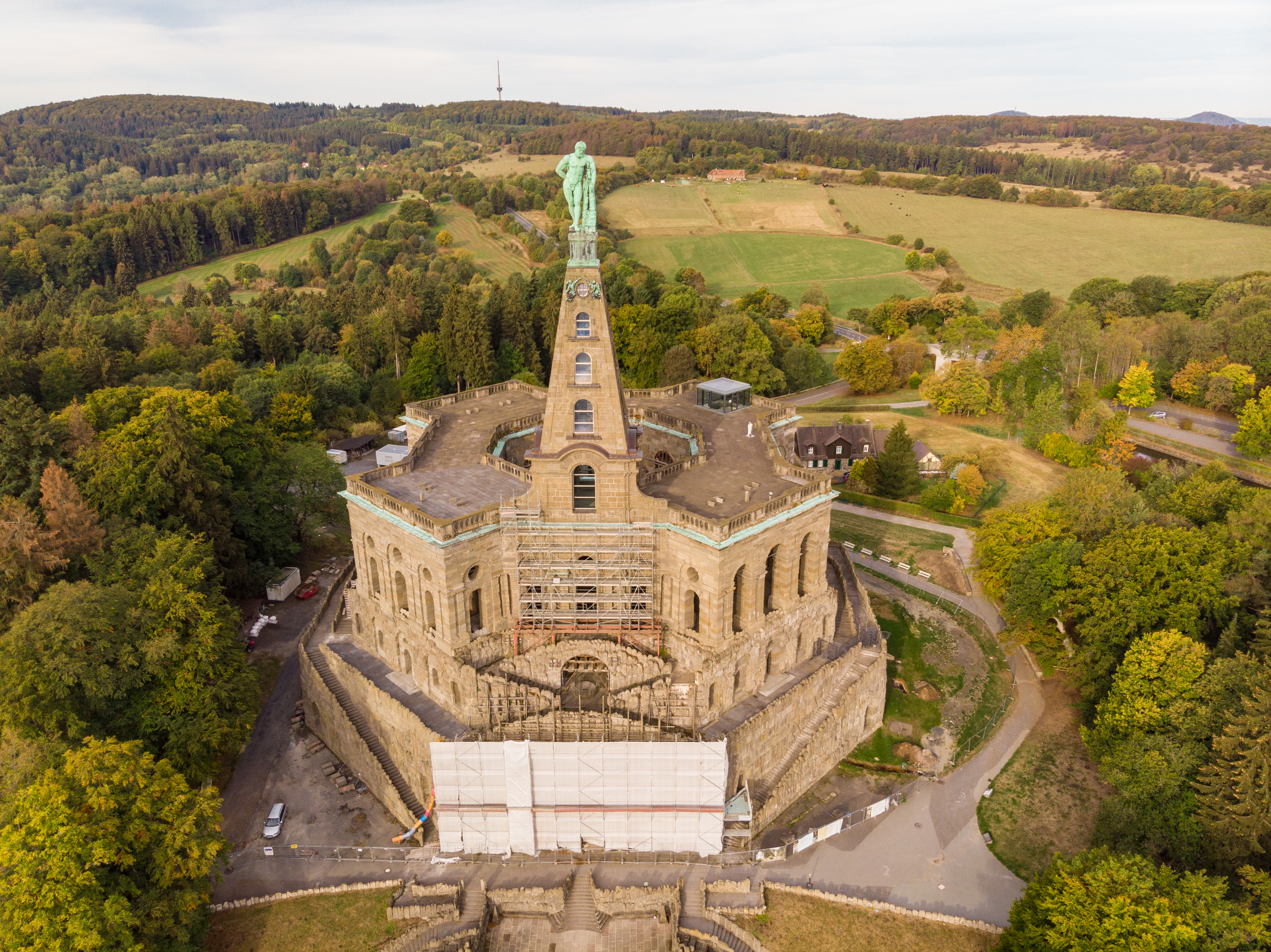
The quinquennial in Kassel — founded 1955 as a reckoning with what Nazism erased, and the institution that, more than any other, sets the curatorial grammar by which contemporary art is read.
Established1955 — 202716 editions (by 2027)
18 June – 25 September 2022
Above
The Fridericianum, Friedrichsplatz, Kassel — Europe's first purpose-built public museum (1779), and the central exhibition site of every documenta since the first edition in 1955.
· Photograph:
Wikimedia Commons
Editorially independent Biennale's coverage is written without sponsor involvement. This placement is reserved for a future edition partner · sponsorship enquiries
Editorial coverage of documenta is independent · Biennale receives no funding from documenta gGmbH or its partners
lumbung
The Lead Essay Three Years After the Lumbung
After the lumbung: the institution that has to repair itself
documenta 15 was both a curatorial proposition with international consequences and the worst public crisis in the institution's history. The 16th, under Naomi Beckwith, opens in 2027.
By the Biennale Editorial Team
documenta is the institution by which other institutions in contemporary art measure their seriousness. Founded in 1955 by Arnold Bode, the painter and exhibition designer who returned to Kassel after the war determined to show German audiences the modern art that the Nazis had banned as "degenerate," documenta was conceived as a one-time exhibition staged in the still bomb-damaged Fridericianum alongside the Federal Garden Show. It became, over five years and a successful second edition, a quinquennial. By 1972, when Harald Szeemann staged documenta 5 as Questioning Reality — Pictorial Worlds Today with its 600,000 visitors and its curator-as-author argument, documenta had become the central exhibition of the twentieth century's most influential art-historical proposition — that the curator could be a critical author rather than an organising clerk. Every consequential biennial since has been organised against, or in homage to, what Szeemann did in Kassel.
documenta fifteen, which opened on 18 June 2022 and closed on 25 September, was the institution's first attempt to extend Szeemann's argument by another full step. The artistic direction was given not to an individual curator but to a collective — ruangrupa, the Jakarta-based group founded in 2000 by Ade Darmawan and a rotating membership of artists and cultural workers. The proposition the appointment carried was that the curator's office could be plural, that the editorial intelligence shaping the world's most consequential contemporary exhibition need not derive from a single signature, and that the prevailing language of the field — Western, individualist, market-coordinated — could be displaced by a different organisational grammar. ruangrupa called that grammar lumbung, the Indonesian word for the communal rice barn that village agricultural economies use to store and redistribute surplus. The selection process they ran was a "harvest" rather than a curatorial decision; the participating artists were "majelis" (assemblies) rather than individuals; the resource-pooling logic was foregrounded in the budget structure of the exhibition itself.
The crisis, and what it broke
What occurred during the exhibition's run is now the most documented public crisis in the institution's seventy-year history. On the second day of the exhibition, a fifty-foot vertical banner by Taring Padi — a Yogyakarta-based artist collective participating as one of the lumbung members — installed at Friedrichsplatz adjacent to the Fridericianum was identified as containing antisemitic caricature: figures with sidelocks and SS uniforms drawn in the visual vocabulary of inter-war European antisemitism. The work, People's Justice, had been produced in 2002 in Indonesia in protest at the Suharto regime; it had not been intended for European audiences and had not, in the curatorial preparation, been read against the European register in which it was being displayed. It was covered the next day, removed within a week, and the international press subsequently identified additional works in the exhibition that drew from antisemitic visual conventions. The German federal culture minister Claudia Roth intervened publicly. The director of documenta, Sabine Schormann, resigned in mid-July. An investigation committee composed of seven senior scholars and curators, chaired by Nicole Deitelhoff, was appointed in August. Its report, published in February 2023, was a careful and severe document. It concluded that the curatorial process had been structurally inattentive to the European reception conditions of works produced in non-European political contexts; that the institutional safeguards documenta had nominally in place had failed; and that ruangrupa's curatorial concept of distributed authority had, in practice, created an absence of curatorial authority at the points where it was most needed.
What the controversy did not establish — what the careful reading of the report made clear it could not establish — was that the underlying curatorial proposition of lumbung was wrong. The exhibition, away from the works that became the crisis, included bodies of work by participating collectives — Atis Rezistans Ghetto Biennale (Haiti), Britto Arts Trust (Bangladesh), CCFK (Korea), Wakaliga Uganda — that would not otherwise have appeared in the official frame of a major European biennial. The participatory logic at the level of small-scale community art organisations — exactly the level at which most working contemporary artists actually operate — produced an exhibition that was, for the attentive visitor, more and more various than any documenta of the post-Enwezor period. The Deitelhoff report acknowledged this directly.
Above
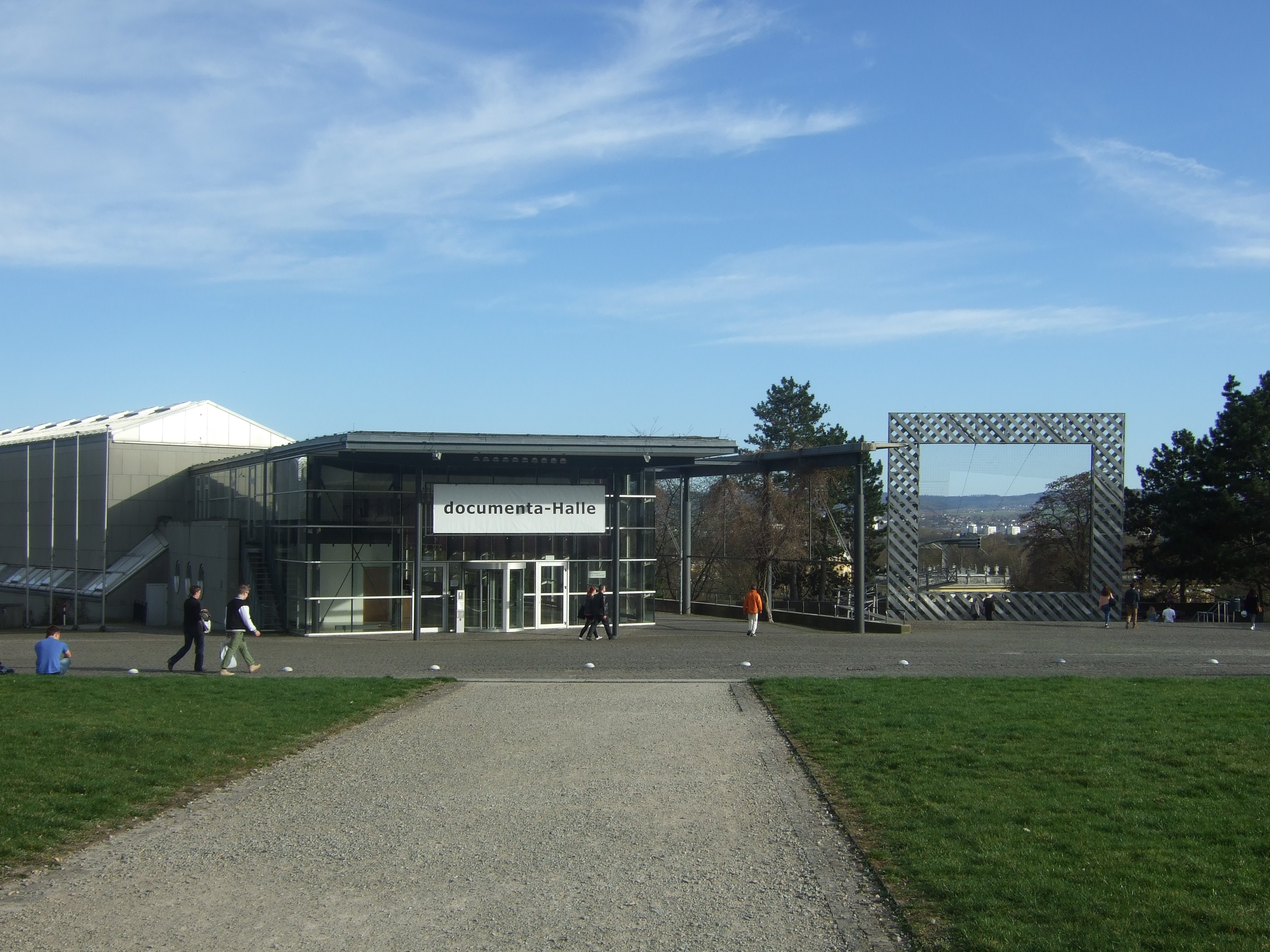
The documenta Halle, Kassel — the purpose-built exhibition hall completed in 1992 for documenta IX, designed by Jourdan & Müller.
· Photograph:
Wikimedia Commons · CC BY 3.0
The interregnum, and what it produced
The 24 months following the 2022 closure were the most institutionally consequential in documenta's history. The board commissioned a second external review, this one on the institutional structure of documenta gGmbH itself, which recommended changes to the artistic-director selection process and a stronger independent curatorial committee. The selection committee for documenta 16 was reformed accordingly through 2023, against a public backdrop of resignations and controversy over the criteria the post-2022 institution would apply. In December 2024 the reformed finding committee named Naomi Beckwith — Deputy Director and Chief Curator of the Solomon R. Guggenheim Museum, New York, since 2021, previously Senior Curator at the Museum of Contemporary Art Chicago — as Artistic Director of documenta 16. Beckwith has since announced the curatorial team she has assembled to work with her: Carla Acevedo-Yates, Romi Crawford, Mayra A. Rodríguez Castro, and Xiaoyu Weng — an all-female team whose combined work covers Latin American, Black diasporic, and East Asian contemporary art histories.
The selection committee for documenta 16 was reformed in the wake of the 2022 controversy. Its task was to produce an Artistic Director who could repair the institution without retreating from the proposition that documenta has always been: a critical experiment, not a curatorial defence mechanism.
— On the 2024 appointment
What Beckwith inherits, and the choice
Beckwith inherits an institution that has both the most permission and the least permission of any documenta artistic director in the post-1972 period. She has the most permission because documenta gGmbH, under the institutional reform process, has committed publicly to giving its artistic director the structural authority it failed to give ruangrupa. She has the least permission because the political and reputational margin for error is, in 2025–27, narrower than it has been since the 1980s. Beckwith's published curatorial work — at MCA Chicago and at the Guggenheim, where she has co-curated major surveys of Cecilia Vicuña and Gabriel Orozco, and where her acquisitions practice has extended the museum's twentieth-century holdings of work by Black, Indigenous, and queer artists — suggests the kind of artistic director who can hold both the editorial ambition documenta has historically claimed and the institutional discipline the 2022 crisis demonstrated it requires.
The opening of documenta 16 is scheduled for the summer of 2027. The international art press has, in the eighteen months since Beckwith's appointment, been unusually disciplined about avoiding the speculative profile that has dogged every recent documenta. Beckwith herself has been almost silent. Whatever she produces will be read in three directions at once — against the lumbung, against the 1972 inheritance, and against the question the institution has not yet been willing to answer aloud: what is the contemporary curatorial form of a quinquennial that has, for seventy years, been the institution by which contemporary art has measured itself.
Critical Perspective The Enwezor Inheritance
documenta 11 still: the postcolonial frame, twenty-three years in
Okwui Enwezor's 2002 edition was the moment documenta accepted that the world was larger than it had been. What it has done with that acceptance is the long argument.
By the Biennale Editorial Team
The most consequential documenta of the post-Szeemann period was the eleventh, curated by Okwui Enwezor in 2002. Enwezor — Nigerian-born, US-trained, co-founder of Nka: Journal of Contemporary African Art, and at the time Adjunct Curator at the Art Institute of Chicago — was the first non-European Artistic Director in documenta's history. His proposition was structural. documenta 11 was organised as five "Platforms": Vienna and Berlin (March–April 2001, on democracy and unrealised democracy); New Delhi (May 2001, on truth, justice, and reconciliation); St. Lucia (January 2002, on Créolité and Creolisation); Lagos (March 2002, on the post-1989 African urban condition); and the Kassel exhibition itself (June–September 2002). The Kassel exhibition was Platform 5 rather than Platform 1; the discursive work was constitutive of the curatorial argument, not promotional to it.
The structural argument Enwezor was making — that contemporary art is constituted by the global postcolonial condition rather than receiving its political content from elsewhere — has been the dominant frame in contemporary art curation for the twenty-three years since. Every major biennial of the post-2002 period has taken Enwezor's distributed-discursive model as either a precedent to extend or a precedent to argue with. documenta 12 (2007, Roger Buergel and Ruth Noack) was structured around three "leitmotifs" (modernity? bare life? what is to be done?) that were explicitly a continuation of the Enwezor frame in a different register. documenta 14 (2017, Adam Szymczyk), titled Learning from Athens, extended the distributed exhibition model by staging the exhibition in Athens for the first half and Kassel for the second — a structural argument about the European debt crisis and Greece's position in it that was, in execution, both compelling and financially calamitous (the exhibition overran its budget by €7 million; the board intervened publicly). documenta fifteen (2022, ruangrupa) extended the Enwezor frame by replacing the single curator with a collective.
What documenta has not done, since 2002, is return to the proposition that there is a single critical or curatorial intelligence that can organise the exhibition by itself. The Enwezor inheritance has been the dominant proposition of the institution for nearly a quarter of a century, and the institution has — alongside its successes — accumulated the institutional debt of that proposition. The crisis of 2022 was, among other things, the moment that institutional debt came due. The distributed-curatorial argument that Enwezor introduced as a methodological commitment in 2002 had, by 2022, become a default. ruangrupa inherited a methodology that had become institutionally unexamined.
This is not an argument for returning to the single-curator model. It is an argument that the next consequential documenta — Beckwith's, or the one after — will have to take the question Enwezor opened twenty-three years ago and ask it differently. The postcolonial frame is now the orthodoxy. The question of who organises contemporary art's institutional intelligence remains the question.
The Institutional Spine
Defining moments
Five episodes from seventy years. The moments at which the institution became different from what it had been before.
19551st Edition
The founding — Arnold Bode and the bombed-out Fridericianum
The first documenta opened on 15 July 1955 in the still-damaged Fridericianum in Kassel, conceived by the painter and exhibition designer Arnold Bode as an attendant exhibition to the Federal Garden Show. 670 works by 148 artists. The premise was to show German audiences the modern art the Nazis had banned and confiscated — Beckmann, Picasso, Kandinsky, Klee, Mondrian, the Bauhaus, Surrealism — at a moment when post-war West German culture was still negotiating what could be shown and remembered.
Sources: documenta archive (Kassel); documenta: Idee und Konzept (1955)
19725th Edition
documenta 5 — Szeemann and the curator-as-author
The fifth documenta, Questioning Reality — Pictorial Worlds Today, was organised by Harald Szeemann into ten sections including "Individual Mythologies," "Reality of the Representation," and "Reality of the Represented." It received 600,000 visitors over 100 days. The principle the exhibition established — that the curator could organise an exhibition around an argument rather than a survey — became the foundation of nearly every consequential biennial in the half-century since.
Sources: Documenta 5 — Befragung der Realität catalogue, 1972
199710th Edition
documenta X — Catherine David and the politics of memory
The tenth documenta was directed by Catherine David, the first woman Artistic Director of the institution. Retrospective & Politics of Memory reasserted documenta's political dimensions after the formalist tendency of the 1980s editions, and inaugurated the discursive-platform model — "100 Days, 100 Guests" — that Enwezor would extend in 2002. David's curatorial position remained controversial throughout the exhibition's run and shaped the institutional debate about what documenta should be.
Sources: Politics—Poetics: documenta X — the Book
200211th Edition
documenta 11 — Enwezor and the five platforms
Okwui Enwezor, the first non-European Artistic Director, structured documenta 11 as five Platforms across Vienna, Berlin, New Delhi, St. Lucia, Lagos, and Kassel. The Kassel exhibition was the fifth and final Platform. The structural argument — that contemporary art is constituted by the global postcolonial condition — has been the dominant frame in international curating ever since.
Sources: Democracy Unrealized and Experiments with Truth (Platform 1 and 2 catalogues); Documenta 11_Platform 5: Exhibition
202215th Edition
documenta fifteen — ruangrupa, lumbung, and the controversy
documenta fifteen was directed by ruangrupa, the Jakarta-based collective; the first collective rather than individual curatorial body in the institution's history. The lumbung framework distributed curatorial authority among participating collectives. The exhibition was marked by an antisemitism controversy beginning on its second day, the resignation of the director, an external investigation, and a 2023 report that prompted institutional reform. Whether documenta could continue under its existing structures was, for several months in 2022–23, a publicly open question.
Sources: documenta gGmbH; Deitelhoff Committee Report, February 2023
The Curators of documenta
The figures behind documenta
Founder · 1st–4th editions
Arnold Bode
German painter, designer, and academician, 1900–1977. Born in Kassel. Pre-war exhibition designer in Berlin; banned from teaching by the Nazis in 1933. Conceived and directed the first four documenta editions (1955, 1959, 1964, 1968) before stepping back from formal artistic direction. The institution's foundational curatorial intelligence and its principal early advocate within German cultural politics.
Swiss curator, 1933–2005. Director of the Bern Kunsthalle (1961–69); subsequently independent curator. His When Attitudes Become Form (Bern, 1969) and documenta 5 (1972) are the two exhibitions by which the contemporary curatorial form was established. Sole Artistic Director of documenta 5; co-curator of the Aperto sections at the Venice Biennale (1980, 1999, 2001).
Nigerian-American curator, critic, and editor, 1963–2019. Founding editor of Nka: Journal of Contemporary African Art. Curator of the 2nd Johannesburg Biennale (1997), documenta 11 (2002), and the 56th Venice Biennale (2015, All the World's Futures). Director of Haus der Kunst, Munich, 2011–18. His distributed-platform model has been the dominant curatorial template of international biennials for the past two decades.
Artistic Director · documenta 16 (2027, in preparation)
Naomi Beckwith
American art historian and curator, born 1976. Deputy Director and Chief Curator of the Solomon R. Guggenheim Museum, New York, since 2021. Previously Senior Curator at the Museum of Contemporary Art Chicago (joined 2011). Appointed Artistic Director of documenta 16 in December 2024 by the reformed finding committee. Has since announced an all-female curatorial team (Carla Acevedo-Yates, Romi Crawford, Mayra A. Rodríguez Castro, Xiaoyu Weng) to develop the 2027 exhibition.
The hundred days, the venues across Kassel, and how to arrive in time for the 16th edition.
The hundred days
documenta is, by founding constitution, a hundred-day exhibition — the formula Arnold Bode set in 1955 and which every subsequent edition has preserved. The exhibition opens in June and closes in mid-September of its year; in between, Kassel is reorganised around the show, with venues operating daily across the heritage and modern fabric of the city.
documenta runs on a five-year cycle, not the more common biennial rhythm. The 15th edition, curated by ruangrupa, ran 18 June – 25 September 2022. The next iteration is documenta sixteen, 12 June – 19 September 2027, under Artistic Director Naomi Beckwith and an all-women core curatorial team. As of mid-2026, the 16th edition's full participating-artists roster and venue list have not been publicly released.
Where documenta happens
The principal venues recur across editions and are walkable from the city centre. The Fridericianum on Friedrichsplatz — Europe's first purpose-built public museum (1779) — has anchored every edition since 1955. The documenta Halle (1992) on Du-Ry-Straße was purpose-built for the exhibition. The Neue Galerie, within the Hessisches Landesmuseum complex on Schöne Aussicht, customarily hosts the historical and archival strands.
Open-air and project sites typically extend into the Karlsaue baroque park along the Fulda, into the Kulturbahnhof at the former main station, and into temporary venues distributed across the city. Each edition publishes its own venue map: the d16 list will appear at documenta.de closer to opening.
Tickets & opening hours
documenta uses a multi-venue pass system that admits visitors to every official exhibition site for the duration of an edition. The 15th edition (2022) sold a day ticket at €27 (reduced €19), a two-day ticket at €45, and a season pass at €125 (reduced €100), with an evening ticket at €12 and free admission for children twelve and under. d16 pricing has not yet been published; expect adjustments at the next edition.
Venues across recent editions have run on a roughly 10:00 to 20:00 daily schedule for the hundred-day run, with some sites closing earlier. Tickets to the priced editions have customarily included free Kassel-Plus public transport on the day of validity. Confirm the current pass formats and hours at documenta.de ahead of travel.
Getting to Kassel
By rail — Kassel-Wilhelmshöhe is the principal long-distance ICE station and the practical arrival point. Frankfurt to Kassel-Wilhelmshöhe runs in around 1 hr 30 min by direct ICE; Berlin via Hannover in roughly 3 hr; Hamburg in around 2 hr 30 min. Kassel Hauptbahnhof, by the Kulturbahnhof venue, serves regional services.
By air — Frankfurt (FRA), around 200 km south, is the workable international gateway, with the ICE running from the airport's long-distance station direct to Kassel. Kassel-Calden (KSF), the small regional airport north-west of the city, operates limited seasonal service. Berlin (BER) and Hamburg (HAM) are the rail-served alternatives.
Within Kassel — tram lines 1, 3 and 4 connect Kassel-Wilhelmshöhe to Friedrichsplatz in around fifteen minutes; the Fridericianum, documenta Halle and Neue Galerie are within a short walk of each other.
When to visit during the hundred days
The opening days in June are the press, preview and vernissage season — the densest concentration of artist talks, public programme and international press, and the highest visitor traffic in the city. Late summer, through July and August, settles into the steady working rhythm of the exhibition: long daylight hours in the Karlsaue, the discursive programme in continuous operation, and steadier circulation through the venues. September brings the closing rush, with regional and German national visitor interest intensifying ahead of the mid-September finissage.
The principal Friedrichsplatz circuit alone — Fridericianum, documenta Halle, Neue Galerie — fills a full day. Allowing three days for the full venue set, including the Karlsaue and the more distant project sites, is the working rule among returning visitors.
Where to stay
Kassel's hotel inventory tightens sharply during the hundred days, particularly across the opening and closing weeks; booking well in advance is the standard counsel. The compact city centre between Friedrichsplatz and the Kulturbahnhof puts the principal venues within walking distance of most central hotels. Visitors on tighter budgets sometimes base themselves in Frankfurt or Göttingen and ride the ICE in — a workable strategy given the rail speeds, though it loses the evening programme.
The official Kassel city tourism office maintains a public directory of registered accommodation at kassel-marketing.de; documenta gGmbH itself does not operate or broker lodging.
Practical details confirmed against documenta gGmbH public communications, documenta fifteen archival ticket records, and Deutsche Bahn published schedules. Pricing, the d16 venue map, and final hours will be updated when officially announced.
My Biennale
Carry the Biennale with you
Save this biennale to your circuit, follow its artists as their pages grow, and sync every opening and closing to your own calendar on the companion app.
Catherine David & Jean-François Chevrier, eds. · 1997
The dense, foundational catalogue that established the discursive-platform model of contemporary biennial curation.
Documenta 11_Platform 5: Exhibition
Okwui Enwezor, ed. · 2002
Together with the Platform 1–4 volumes, the most consequential curatorial publication of the post-1990 period.
The Documenta Report
Nicole Deitelhoff et al. · February 2023
The investigation committee's full report on documenta fifteen. Available as a public PDF from documenta gGmbH.
Documenta: A Brief History of the Exhibitions
Harald Kimpel · DuMont
The standard one-volume history through documenta 13. German-language; not yet translated.
Show Time: The 50 Most Influential Exhibitions of Contemporary Art
Jens Hoffmann, ed. · Thames & Hudson
Includes chapters on documenta 5, X, and 11.
lumbung — documenta fifteen Handbook
ruangrupa, ed. · Hatje Cantz, 2022
The curatorial document of documenta 15. Reads differently after the Deitelhoff report.
Images, attribution & rights
Photographs are reproduced from Wikimedia Commons under the Creative Commons licences stated in each caption. Credit and a link to the source file are provided in every case. If you are the photographer of an image used here and wish to discuss its use, please write to rights@biennale.com; we will respond promptly.
Editorial content is original and credited to the Biennale Editorial Team. No image, essay, or other editorial element on this page may be reproduced commercially without written permission. Quotation under fair dealing or fair use for review, scholarship, or news reporting is welcomed and need not be cleared.