The longest-running survey of contemporary American art, staged by the Whitney Museum since 1932, biennial since 1973, and the institution where the country's art has staged its arguments with itself for nearly a century.
Above
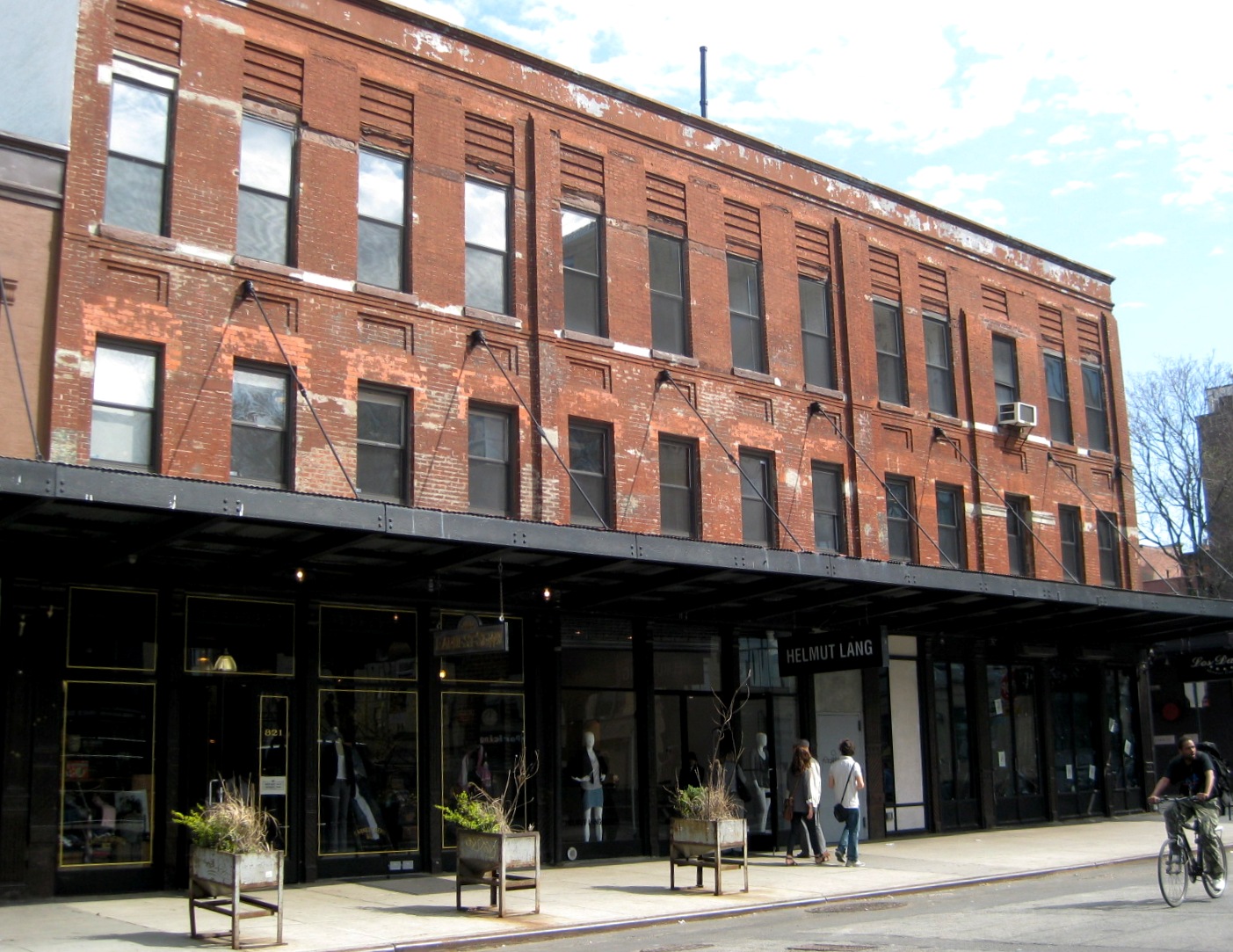
The Whitney Museum of American Art, 99 Gansevoort Street: Renzo Piano's 2015 building at the southern terminus of the High Line.
· Photograph:
Wikimedia Commons
On view now
The 82nd Whitney Biennial, curated by Marcela Guerrero and Drew Sawyer, opened on March 8, 2026; its last section, on Floor 6, remains on view through October 12, 2026.
Editorial coverage of the Whitney Biennial is independent · Biennale receives no funding from the Whitney Museum
Real Thing
The Lead Essay The 81st Edition
Iles, Onli, and the real thing
The 2024 Whitney Biennial took artificial intelligence as its working premise without becoming an exhibition about it. What it argued, and what it didn't.
By the Biennale Editorial Team
The Whitney Biennial is the exhibition by which contemporary American art has, since 1973, been measured against itself. Before 1973 the survey was an annual (separated by medium until 1973, biennial after), and before 1932 it did not exist. The Whitney Museum founded the Annual in 1932 as a contribution to a New York art ecology that had been organised, before that, around the salon-style invitations of the National Academy of Design. Juliana Force, the Whitney's first director and a Mrs. Whitney appointee, organised the Annual as an open-submission exhibition that explicitly broke with the Academy's gatekeeping. The Biennial that the Annual became is one of the most consequential institutional inheritances any American museum has tried to maintain.
The 2024 edition (the 81st Annual or Biennial in the institution's count) was curated by Chrissie Iles, the Whitney's Anne and Joel Ehrenkranz Curator since 1997, and Meg Onli, the independent curator and writer who had previously been Andrea B. Laporte Curator at the Institute of Contemporary Art Philadelphia. The exhibition's title, Even Better Than the Real Thing, was borrowed from U2 (a 1992 single from Achtung Baby); the working premise, as Iles and Onli described it in their curatorial essay, was the relationship between artificial intelligence, racialised and gendered identity, and the long American argument about what a "real thing" might be. The premise was not pursued as theme. The exhibition included almost no work that took artificial intelligence as its subject matter. Instead the curators built an exhibition in which the proposition functioned as an analytical frame for selections that ranged from American Indian Movement archival recovery to ASMR-influenced sound work to the painterly figurative tradition.
The substance of the selection
The seventy-one selected artists and collectives were younger and more diverse than the recent Whitney average, and the curatorial selection foregrounded artists working at the edges of institutional reception. Demian DinéYazhi' (Diné) contributed a text-based LED installation whose flashing capitals were widely reported to contain an embedded message in support of Palestinian liberation, a circumstance the museum did not publicly contest. Carolyn Lazard's video installation drew on the visual vocabulary of theatre curtains. Suzanne Jackson, whose career began in Los Angeles in the 1960s and 1970s and whose work had only recently entered the major institutional record, was given a substantive presence. Nikita Gale, Pippa Garner, and other artists whose practices had been under-recognised by the institutional apparatus formed a quiet but legible spine through the floors.
The exhibition opened on 20 March 2024 and closed on 11 August. Critical reception was substantial; the consensus position by July was that the edition was the institution's most controlled and most curatorially intelligent Biennial since 2014, the first in the new Renzo Piano building. The argument-by-omission was strongest. Iles and Onli refused the option of putting on an "AI exhibition" at exactly the moment a number of American museums were doing exactly that. The exhibition declined the temptation to be of-the-moment and was, in consequence, the most of-the-moment Biennial in some time.
Above
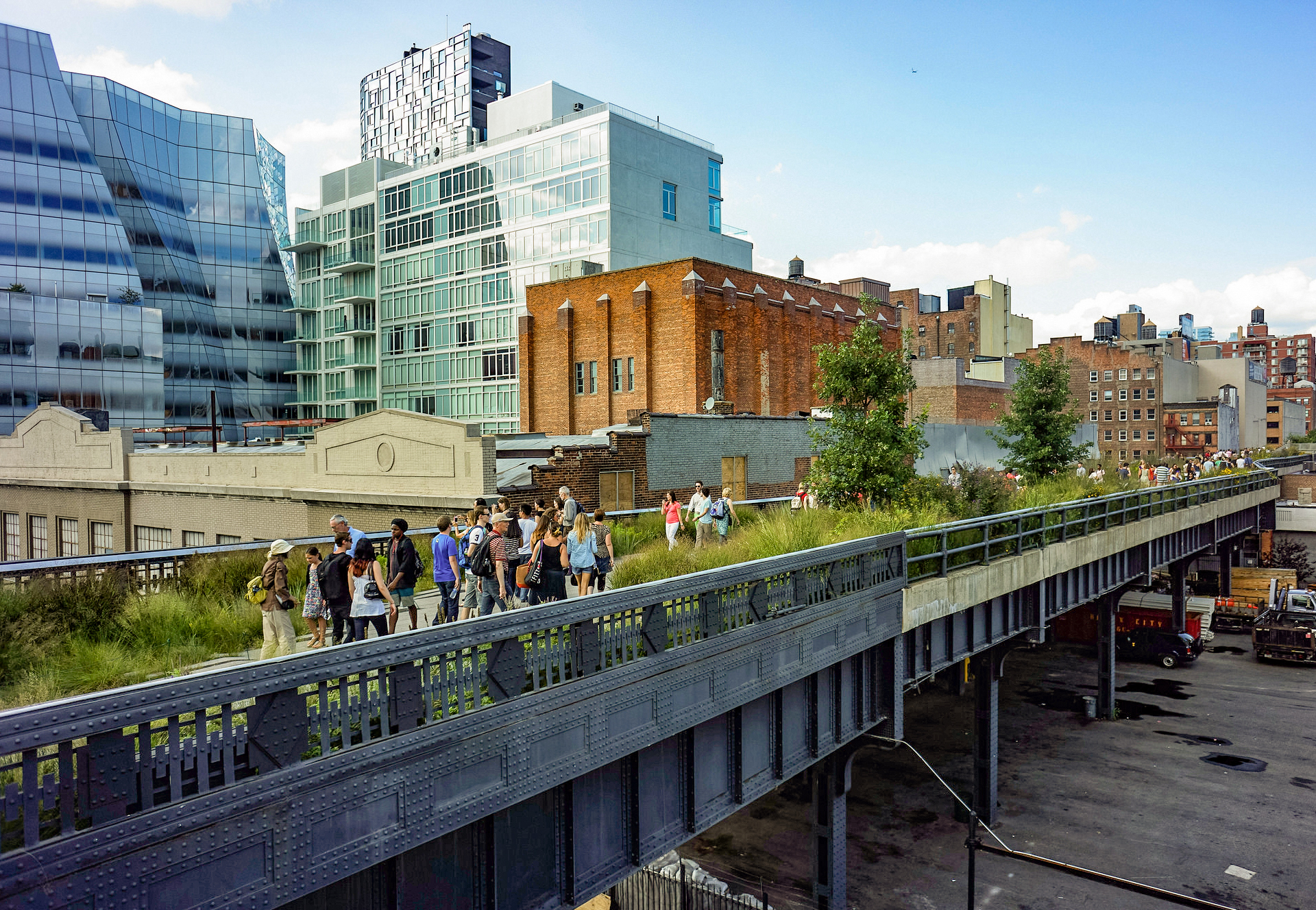
The southern end of the High Line: the elevated park that arrives at the Whitney's front door and changed the gravity of New York's gallery district.
· Photograph:
Dansnguyen, Wikimedia Commons · CC0
The institution behind the exhibition
What is harder to write about, and consequential, is that the 2024 Biennial was the first under Scott Rothkopf as director of the Whitney. Rothkopf (Senior Deputy Director since 2017 and Chief Curator before that) was named director in May 2023, succeeding Adam Weinberg, who had directed the museum since 2003 and who oversaw both the 2014 move to the Piano building and the 2017 and 2019 Biennials and their controversies. Rothkopf's directorship has not yet produced a Biennial of its own selection (the 2024 edition was prepared during the transition), but the institution's posture has visibly changed. The museum has been quieter, more disciplined, and less inclined to use the Biennial as a vehicle for institutional statements. Whether this is read as restraint or as retreat turns on the 2026 edition, which opened on March 8, 2026, curated by Marcela Guerrero (the Whitney's DeMartini Family Curator, whose work has centred Latinx art at the institution) and Drew Sawyer, the Sondra Gilman Curator of Photography, who joined the Whitney from the Brooklyn Museum in July 2023. The appointment was announced in August 2024.
The 2024 Biennial declined the temptation to be of-the-moment and was, in consequence, the most of-the-moment Biennial in some time.
On the 81st survey
The institutional question the Whitney has been asking itself for the past decade is whether the Biennial is the exhibition format the museum should continue to organise itself around. The 2017 Open Casket controversy and the 2019 Warren Kanders boycott both arose at the Biennial, both prompted internal reform, and both demonstrated that the format produces a level of public attention that other American museum exhibitions do not approach. The 2024 edition shows the Whitney working out what the Biennial can be after that decade of strain: an exhibition that does its work without offering itself as a hostage to the surrounding political weather. Whether this is the institutional posture the museum should permanently adopt is a question worth keeping open.
Critical Perspective The Long American Argument
After 1993, after 2017, after 2019
Three Whitney Biennials produced the institutional arguments the museum has been working through ever since. None has been fully resolved.
By the Biennale Editorial Team
The 1993 Whitney Biennial, curated by Elisabeth Sussman with John Hanhardt, Lisa Phillips, and Thelma Golden, is the edition by which every subsequent Biennial has been measured. The exhibition, mounted in the Marcel Breuer building on Madison Avenue, foregrounded artists working with race, gender, sexuality, and class as the constitutive categories of contemporary American art-making. Daniel Joseph Martinez's admission badges famously read, when read in sequence, "I can't imagine ever wanting to be white." The reception was sharply divided at the time. In the historical record it has settled: the field of artists, critics, and curators that emerged in the 1990s read the 1993 Biennial as the most consequential American exhibition of the decade, and museum historiography now treats it as the moment when American contemporary art accepted that the politics of identity were not a category external to art-making but constitutive of it.
The 2017 Whitney Biennial, curated by Christopher Y. Lew and Mia Locks, included Dana Schutz's Open Casket, a painting based on the famous photograph of Emmett Till's mutilated body in the open casket at his funeral, taken in 1955 and circulated by Mamie Till as a deliberate act of political witness. On the third day of the Biennial's run, the British-Black artist Hannah Black published an open letter to the curators and the Whitney calling for the painting's removal and destruction. The letter's argument was that Schutz, as a white artist, could not paint Till's death without participating in the same image economy that had failed to prevent it; the painting's status as an object that could be sold (Schutz subsequently confirmed she would not sell it) made the offence material. The letter generated months of public argument. The Whitney refused to remove the painting; Schutz declined to withdraw it; the curators issued a statement defending the inclusion. Black's letter has been the most influential single document of art-world criticism since the 2014 Biennial of Sydney withdrawal letter.
The 2019 Whitney Biennial, curated by Rujeko Hockley and Jane Panetta, included artists who, two months after the exhibition opened, signed an open letter calling for the resignation of Warren Kanders, vice chair of the Whitney board and owner of Safariland, the manufacturer of tear gas canisters that had been deployed against migrants at the US-Mexico border. Eight artists withdrew their work from the Biennial during the run. Kanders resigned from the board on 25 July 2019. Forensic Architecture's video Triple-Chaser, presented in the 2019 Biennial, documented the deployment of Safariland tear-gas canisters against migrants at the US–Mexico border; the work was the central piece of evidence the campaign was built around. The action is the most successful artist-led institutional reform in American museum history; the precedent it set has shaped subsequent decisions at the Metropolitan Museum (the Sackler removals), the Guggenheim (the Sackler removals), and the Tate (the BP withdrawal).
Each of these three Biennials produced institutional arguments that the Whitney is, as of 2025, still working through. The 1993 question, about whose identity is at the centre of an "American" art, was resolved at the level of art-making and is unresolved at the level of museum governance. The 2017 question, about who can paint whose suffering, has produced a curatorial caution that some readers experience as integrity and others as self-policing. The 2019 question, about who funds American museums and what they require in return, produced the reform but did not produce the framework that would prevent the next analogous crisis. The Biennial has been the institutional surface on which these arguments have been staged; whether the Biennial is the right institutional form to keep staging them is the question the Whitney has not asked aloud.
The Institutional Spine
Defining moments
Five episodes from ninety-three years. The moments at which the Biennial, or the Annual before it, became different from what it had been before.
19321st Annual
The first Whitney Annual under Juliana Force
The first Whitney Annual opened in November 1932 at the Whitney Museum of American Art's original 8 West 8th Street building, organised by founding director Juliana Force. The Annual broke explicitly with the salon-style invitations of the National Academy of Design and was conceived as a survey of contemporary American art selected by museum curators rather than by an academy committee. The Annual ran until 1973, when it became the Biennial.
Sources: Whitney Museum archives; Juliana Force and American Art (1949)
19731st Biennial
The Annual becomes the Biennial
In 1973 the Whitney converted the Annual into a Biennial. The 1973 Biennial, the first under the new format, opened in the Marcel Breuer building on Madison Avenue (occupied since 1966) and was the inaugural edition under the format the institution has maintained ever since.
Sources: Whitney Museum archives
1993Sussman Biennial
The identity politics edition
The 1993 Biennial, curated by Elisabeth Sussman with Thelma Golden, John Hanhardt, and Lisa Phillips, is the single most consequential American Biennial in the institution's history. Its foregrounding of race, gender, sexuality, and class as constitutive categories of contemporary art-making was, at the time, polarising; in the historical record it is the moment when American art accepted that the politics of identity were inside, not outside, the work.
Sources: 1993 Biennial Exhibition catalogue; The Sussman Biennial, Whitney archives
2017Schutz / Black
Dana Schutz's Open Casket and Hannah Black's letter
The 2017 Biennial, curated by Christopher Y. Lew and Mia Locks, included Dana Schutz's painting Open Casket, based on the famous photograph of Emmett Till. Hannah Black's open letter calling for the work's removal and destruction generated months of international debate. Neither the Whitney nor Schutz withdrew the painting; the argument changed both the curatorial caution of subsequent American Biennials and the public understanding of how museum decisions can be contested.
Sources: The New York Times, March–April 2017; Artforum, April 2017
2019Kanders boycott
The Warren Kanders resignation
Two months into the 2019 Biennial, run, eight artists withdrew their work to protest Warren Kanders's position as Whitney vice chair. Kanders, the owner of Safariland, the manufacturer of tear gas used at the US-Mexico border, resigned from the Whitney board on 25 July 2019. The action is the most successful artist-led museum-governance reform in American history and the proximate precedent for Sackler-related withdrawals at the Met, the Guggenheim, the Tate, and the National Portrait Gallery.
Sources: The New York Times, July 2019; Hyperallergic, July 2019
People in the Biennial's History
The figures behind the Biennial
Founding Director
Juliana Force
American museum director and curator, 1881–1948. The first director of the Whitney Museum of American Art (1930–48), having served as Gertrude Vanderbilt Whitney's principal advisor at the Whitney Studio Club from 1914. She organised the first Whitney Annual in 1932 and shaped the institution's foundational commitment to surveying contemporary American art outside the salon framework of the National Academy.
British-American curator. Anne and Joel Ehrenkranz Curator at the Whitney Museum since 1997. Previously Curator at the Museum of Modern Art Oxford. Her curatorial focus on time-based media (film, video, sound) has shaped the Whitney's holdings of moving-image work and her exhibitions of Yoko Ono, Marina Abramović, and Bruce Nauman are reference points for the field. Has co-curated three Whitney Biennials (2004, 2006, 2024).
American curator and writer. Previously Andrea B. Laporte Curator at the Institute of Contemporary Art, University of Pennsylvania, where her exhibitions included Speech/Acts (2017), The Sun Rises in the Evening (2022), and major presentations of artists including Sondra Perry, Cameron Rowland, and Tiona Nekkia McClodden. Co-curator (with Chrissie Iles) of the 2024 Whitney Biennial; subsequently Co-Curator of the Whitney Biennial.
British-Caribbean artist and writer, born 1981 in Manchester. Visual practice in video and installation, plus essays in The New Inquiry, Texte zur Kunst, and e-flux journal. Her March 2017 open letter to the curators of the Whitney Biennial calling for the removal and destruction of Dana Schutz's Open Casket is the most consequential single document of art criticism of the past decade. Author of Tuesday or September or the End (2022).
The 82nd Whitney Biennial opened on March 8, 2026 with a staggered closing: Floor 5 closed August 23, Floor 1 closed September 7, and the final section on Floor 6 remains on view through October 12, 2026.
Who curated the 2026 Whitney Biennial?
The 2026 Whitney Biennial, the 82nd edition, is curated by Marcela Guerrero and Drew Sawyer of the Whitney Museum of American Art. The previous edition, in 2024, was curated by Chrissie Iles and Meg Onli.
Where is the Whitney Biennial held?
The Whitney Biennial is held at the Whitney Museum of American Art, 99 Gansevoort Street in New York's Meatpacking District, in the Renzo Piano building that opened in 2015 at the southern end of the High Line. Visit information.
When did the Whitney Biennial start?
The Whitney Museum began its survey of contemporary American art as an Annual in 1932 and has staged it as a biennial since 1973, making the Whitney Biennial the longest-running survey of contemporary American art. The 2026 edition is the 82nd.
My Biennale
Carry the Biennale with you
Save this biennale to your circuit, follow its artists as their pages grow, and sync every opening and closing to your own calendar on the companion app.
Catalogue history of the first 18 Biennials. The standard institutional reference.
1993 Biennial Exhibition
Elisabeth Sussman et al., 1993
The catalogue of the most consequential Biennial in the institution's history. Increasingly difficult to find.
Open Letter to the Curators and Staff of the Whitney Biennial
Hannah Black · March 2017
Re-published in multiple venues; original on the Facebook page of the artist. Reads differently in 2025.
Even Better Than the Real Thing — Whitney Biennial 2024
Iles & Onli, eds., 2024
The 2024 catalogue with curatorial and contributor essays.
Show Time: The 50 Most Influential Exhibitions of Contemporary Art
Jens Hoffmann, ed. · Thames & Hudson
Includes the 1993 Whitney Biennial as Exhibition #16.
Juliana Force and American Art
Lloyd Goodrich, 1949
Memorial volume on the Whitney's founding director.
Images, attribution & rights
Photographs are reproduced from Wikimedia Commons under the Creative Commons licences stated in each caption. Credit and a link to the source file are provided in every case. If you are the photographer of an image used here and wish to discuss its use, please write to rights@biennale.com; Biennale will respond promptly.
Editorial content is original and credited to the Biennale Editorial Team. No image, essay, or other editorial element on this page may be reproduced commercially without written permission. Quotation under fair dealing or fair use for review, scholarship, or news reporting is welcomed and need not be cleared.